

Theatre Department to present “The Boys Next Door”
Theater
The Hesston College Theatre Department will present its first production of the academic year, “The Boys Next Door,” at 7 p.m. Nov. 11, 12, 18 and 19 and at 3 p.m. Nov. 20 in the Northlawn Studio Theatre on the Hesston College campus.
“The Boys Next Door,” by Tom Griffin, tells the story of four developmentally disabled men who live together in a group home in a New England city and their “burned out” social worker, Jack.
“The play is not a narrative story, but a montage of scenes from the men’s lives,” said second year director Laura Kraybill. “It gives the audience a glimpse into a culture that many people are not familiar with and shows how family and society can have a profound impact on people.”
Kraybill notes that the cast of students does an excellent job portraying each character’s personality. Lead actors include freshmen Cameron Ponce (Elkhart, Ind.), David Rudy (Manheim, Pa.), Simeon Taylor (Girard, Kan.), Nathan Bray (Galva, Kan.), and sophomore Robert Howell (Newton, Kan.).
“I like to do plays that get people thinking and encourage them to be more emotionally generous,” said Kraybill. ‘“The Boys Next Door’ does that through its humor and vulnerability. I hope it helps people rethink the way in which they judge others and what is ‘normal.’”
Running time is about two hours including intermission. Parental guidance is suggested due to language and some difficult content.
Ticket prices are $8 for adults and $5 for students and senior citizens (65+). Tickets can be purchased through the Hesston College Bookstore in person, by phone at 620-327-8105 or online at books.hesston.edu. Tickets will also be available at the door 30 minutes before each show and are subject to availability.
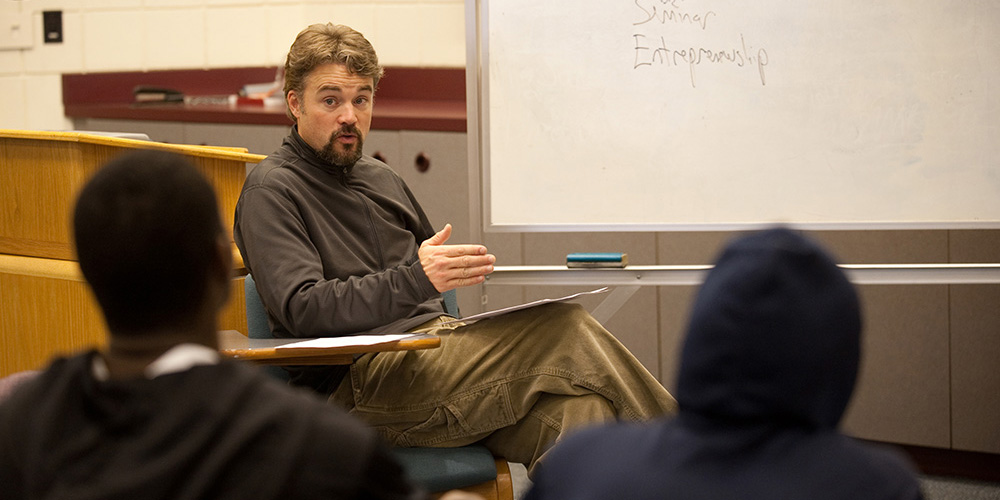
When the teacher becomes the student
Business
Hesston College exists as a place of learning for students – academically, spiritually and socially. It’s why the college’s founders dreamt it into existence 102 years ago.
At Hesston, professors sometimes double as ones who not only teach, but also learn from students.
Business instructor, David LeVan, now in his third year at Hesston, fully embraces the idea of assessments – such as student, faculty and alumni evaluation surveys – as learning tools for improving his classes and discovering ways a new generation of students learns best.
“I am a firm believer in assessment because it is a way to visually see where improvement is needed,” said LeVan. “All criticism contains a kernel of truth, and while it’s not always fun to hear it can be a clear indicator of where change is needed.”
After his first year of teaching, students in LeVan’s Business Communication and Exploring Business classes evaluated the courses using the Individualized Developmental Education Assessment (IDEA) survey. To LeVan’s dismay, both courses scored below the Hesston College average.
LeVan wanted to ensure his students were getting the most from his courses, so he studied the survey results and addressed the areas students indicated having the most trouble or lack of comprehension. One year later, the scores from the student survey came back showing vast improvements in all areas.
“I like teaching because it allows me to continuously improve as an instructor and strengthen the content of my courses,” said LeVan. “Assessment vehicles like the IDEA survey force me to confront weaknesses and offer me the opportunity to improve and grow.”
Surveys and other self-assessment tools have been used at Hesston for many years, but were primarily locally generated until the fall of 2006 when the college made the switch to using nationally recognized and normed assessment methods like the IDEA survey.
IDEA provides institutional information, results for individual courses and measures the students’ perception of the quality of the course and instruction. Since the college’s first run with IDEA in 2006, summary results show the percent of Hesston College courses ranking above average among the other 380 two-year and four-year institutions that use the survey increased from 51 percent to 76 percent during the spring 2011 semester. IDEA states that “when this percentage exceeds 60 percent, the inference is that the college’s overall instructional effectiveness was unusually high.”
Translation: overall, Hesston College has unusually effective instructors.
“Assessment allows the faculty as a whole to identify areas we don’t meet the benchmarks we set for ourselves and find ways to improve,” said Dr. Sandra Zerger, vice president of Academics at Hesston. “Improvements do not happen automatically. It’s a process of evaluation and receiving the information and support to make changes. I think, as a whole, faculty recognize the value in assessment because they see the progress that has been made.”
“I appreciate that Hesston College encourages us to ask, ‘How can we do better?’ and then actually works toward doing better,” said LeVan.
Hesston instructors are required to use the IDEA survey in at least one course every semester. LeVan uses it in every class every semester.
“I want to track the progress of my classes,” said LeVan. “I want to find the gaps throughout the course and improve those areas from one year to the next. After my first year, I realized that my students were unclear about what I was doing in class. I redesigned my curriculum to be very outcome driven. I want my students to understand what I expect. I hope they feel empowered by that.”
The results from year one to year two indicate that the changes LeVan implemented made a difference to his students as each measured benchmark area significantly improved.
“David’s classes are never about memorization, but about understanding concepts and applying them to real life settings” said sophomore Joel Murray of Hesston, Kan. “I feel prepared in his classes because he makes sure we have a good grasp of the course content.”
In an effort to be a better resource to his advisees, LeVan also performed a transferability audit on the college’s business courses and those of schools where many Hesston students transfer. His findings gave him a clearer picture of how to guide students through their first two years of a business program and how to make the transfer process work.
“It is critical that we know what our students need to transfer and the courses they have to take in order to be successful,” LeVan said. “We have an obligation to ensure Hesston College students are well prepared to move on after two years.”
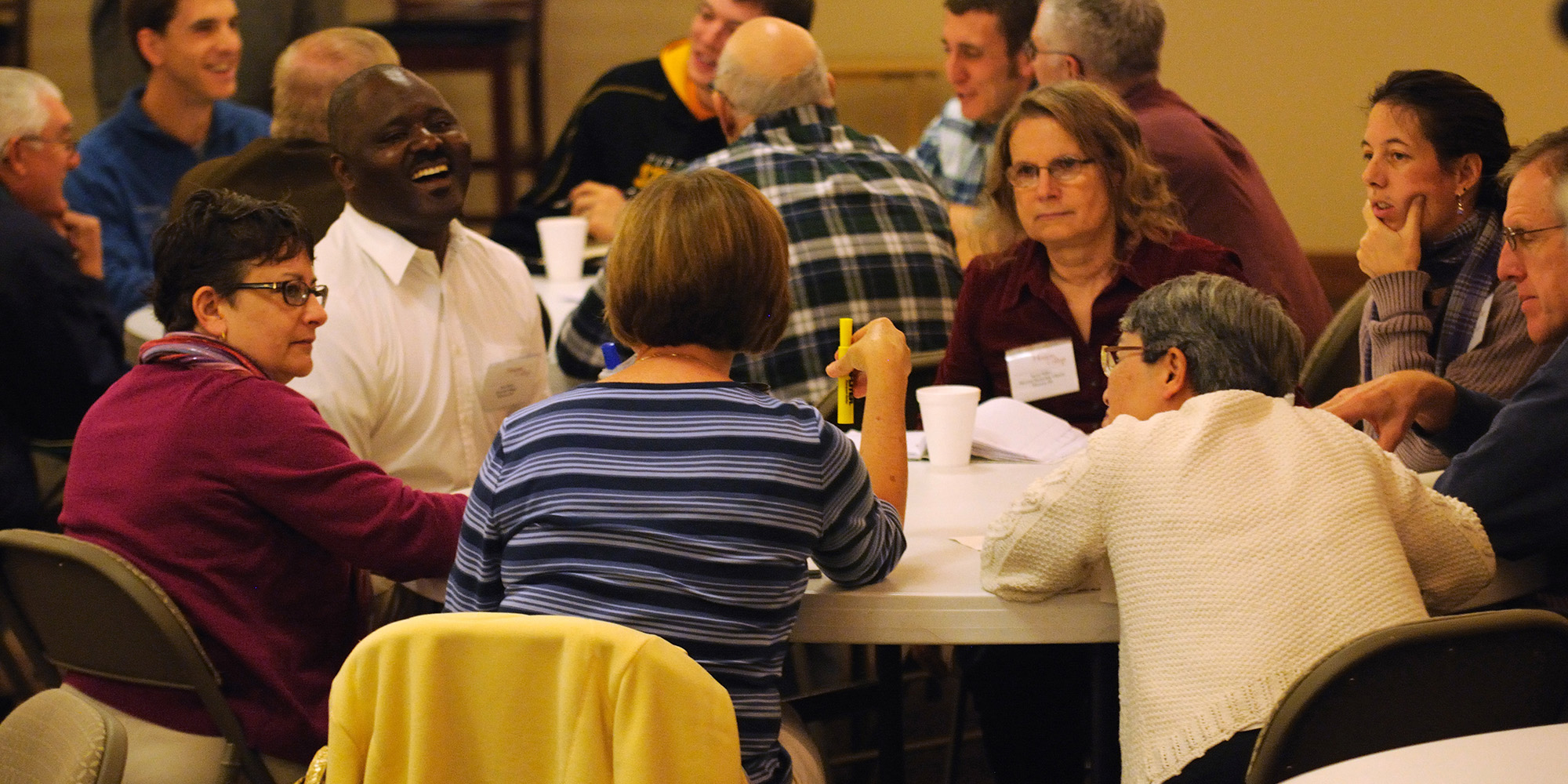
Conference explores ways to be inclusive
Bible and Ministry
Pastors, students, church leaders and members and other interested people gathered for the 12th annual Anabaptist Vision and Discipleship Series (AVDS) at Hesston College October 28 to 30. The theme for 2011 was “Getting Beyond Them and Us – to We.”
Speaker presentations and breakout sessions with topics chosen by participants were used to discuss the tension of the church’s call to be both distinctive and open to those who are unfamiliar with Anabaptist or Mennonite theology.
Hal Shrader, pastor of Trinity Mennonite Church (Phoenix, Ariz.), pointed to Acts 15 to remind participants that cultural differences are a historical part of the church, but that those differences should not hinder the church to reach out to new people.
“We need to make space for people without burdening them or unsettling their minds,” said Shrader.
Speaking as one who was attracted to the Mennonite church because of the theology and the way he saw theology being lived out, Shrader stressed to participants that it is important for church members to remember that new people are not attracted to the Mennonite church because of the rich heritage and traditions.
“People are seeking an alternative to the mainstream culture,” said Shrader. “They come because they are attracted to what Mennonites believe and the ways those beliefs get lived out.”
Shrader, along with Joanna Shenk, associate for Interchurch Relations and Communication with Mennonite Church USA in Elkhart, Ind., and Anton Flores-Maisonet, co-founder of Alterna, a missional community of U.S. citizens and Latin American immigrants in LaGrange, Ga., were the featured speakers for the weekend.
None of the three grew up in the Mennonite tradition, but chose Anabaptist faith and theology in their adult lives. Throughout the weekend, they shared their personal stories of discovering and approaching Anabaptism and Mennonites.
Like Shrader, Flores-Maisonet was not attracted to the cultural practices that are often defined and highlighted within Mennonite communities.
“The best way to introduce new people to the church is to fully incarnate the values you claim,” said Flores-Maisonet. “I was attracted to peace and justice and diversity in the Anabaptist tradition.”
Flores-Maisonet, who grew up in the Catholic church, left his tenure-track social work faculty position at a United Methodist college to live in solidarity with unwelcomed Latin American immigrants through Alterna.
“God wove seemingly unconnected threads into my life that led me to Anabaptism,” said Flores-Maisonet. “Now I am sharing my life in a very intentional way.”
For Shenk, Mennonite worship seemed to lack the vitality she was familiar with in her evangelical upbringing.
“During my first encounters with Mennonites, I felt the theology lacked a vibrant spirituality,” said Shenk. “I wasn’t thinking about the importance of community and loving one’s neighbor and the other things that Mennonites understand and do so well. I found people in the church who would wrestle through my questions with me and I came to view a vibrant faith differently.”
Even as the speakers encouraged participants to remember the history of the Mennonite church and theology, they discussed practical ways to be inviting for those unfamiliar with it.
“Christ is the center of the Christian tradition,” said Flores-Mainsoet. “We only need to see the disagreements in the church as insignificant and keep our eyes on the prize. We have a wonderful opportunity as one stream of living water that understands that only through self-giving love can we ever understand what true reconciliation looks like.”
Participants broke into groups for several sessions to discuss topics of their choosing and that offered opportunities to share and learn from one another’s experiences in their own churches. Some topics included “Deciding what it means to be a Mennonite,” “The centrality of Jesus in a world of religious pluralism,” “How to make baptism about true conversion” and “Being a peace community in a world of violence and injustice.”
“This weekend I gained a new perspective on what it means to be Mennonite and how I probably come off to those who aren’t familiar with the church,” said Aimee Kauffman who attends Journey at Yoder (Kan.), a satellite congregation of South Hutchinson (Kan.) Mennonite Church. “It’s good to be made aware of when we might come across as exclusive and to think about effective ways to communicate our beliefs with others.”
Hesston campus welcomes basketball season with Hoopla
Athletics
Hoopla, a campus-wide pep rally to celebrate the start of the Hesston College men’s and women’s basketball seasons, will begin at 7 p.m. Sunday, Oct. 30 in Yost Center on the Hesston campus. Hoopla is open to the public and free of charge. Fans not able to attend can watch Hoopla live by clicking on the TV icon on the men’s and women’s basketball schedules on the Hesston website.
A dunk contest and three-point shoot-out are just some of the activities planned in what promises to be an entertaining evening.
This year’s rosters include more than 30 student-athletes from 11 states. Coaches Dan Harrison (women) and Dustin Galyon (men) each anticipate a great season. Both coaches are entering their fourth year at the helm of Hesston College basketball.
“We’ll be fun to watch,” Harrison said. “Our returning players will be key for us. I’m looking forward to seeing what we’re capable of.”
“We believe we can compete, win and get better every time we hit the floor,” Galyon said. “Our chemistry has been great. We’re deeper than we’ve ever been which is exciting for our players and us as a coaching staff. The guys have enjoyed competing together and pushing each other.”
The Hesston College women’s and men’s basketball seasons get under way on Tuesday, Nov. 1, with home games versus Union College (Lincoln, Neb.) at 6 and 8 p.m., respectively.
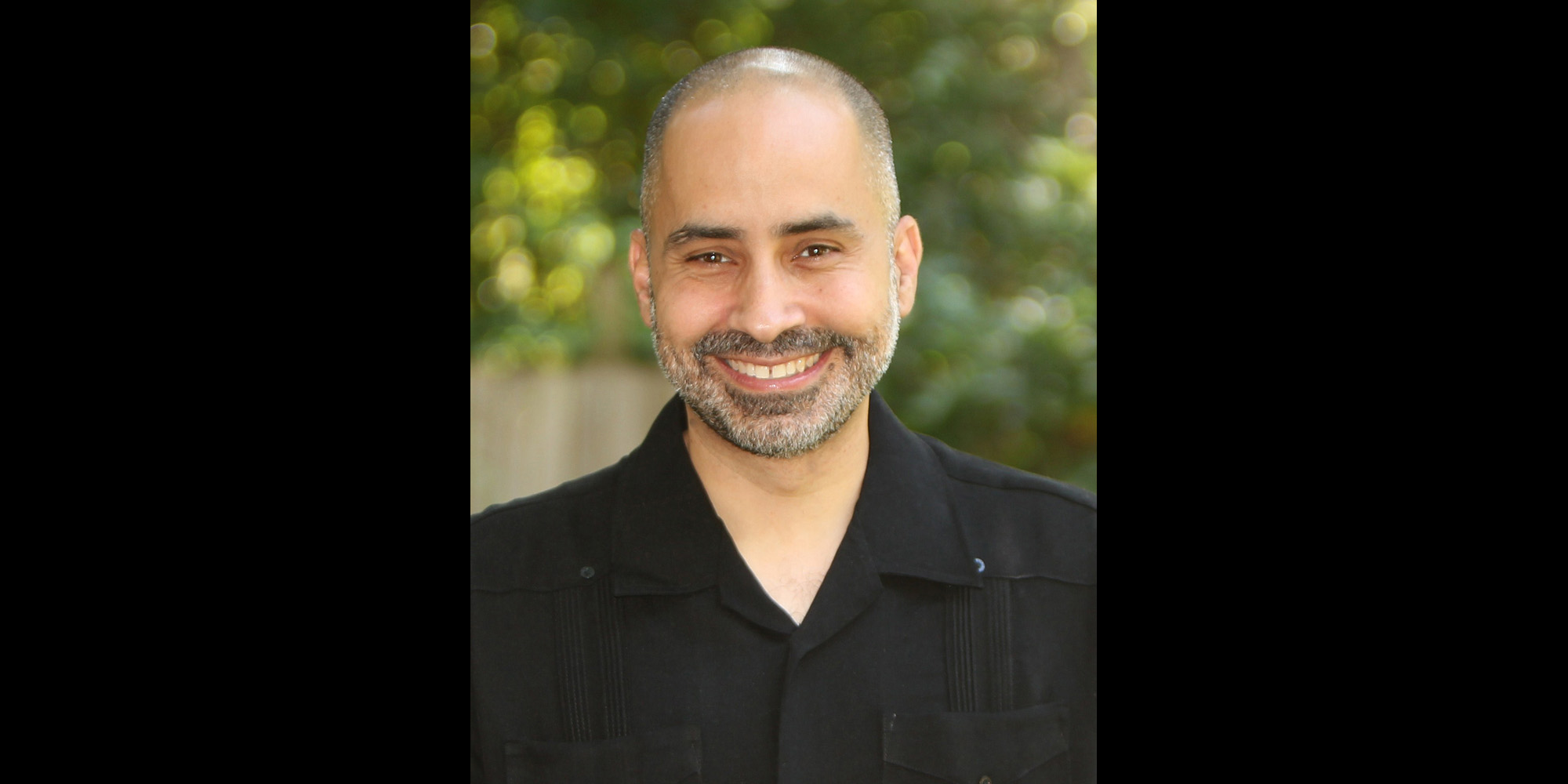
Hesston College to host Flores-Maisonet as church leader in residence
Bible and Ministry
Anton Flores-Maisonet, the co-founder of Alterna, a missional community of U.S. citizens and Latin American immigrants in LaGrange, Ga., will serve Hesston College as church leader in residence Oct. 30 to Nov. 2.
Flores-Maisonet left his tenure-track social work faculty position at a United Methodist college in 2006 to follow a call to live in solidarity with unwelcomed Latin American immigrants through Alterna. The organization emphasizes hospitality to strangers and those in need, reconciliation for broken relationships, environmental stewardship and simple living. He also advocates for justice at Alterna’s off-spring El Refugio, the nation’s first hospitality house located outside an immigrant detention center.
His service to the church and world also includes serving as a steering committee member for Christian Peacemaker Teams and as a board member of Discovering Opportunities for Outreach and Reflection (DOOR), a faith-based network of urban service-learning programs. He has taught three summers in Guatemala at the Central American Study and Service (CASAS) program and at the Latin American Anabaptist Seminary (SEMILLA). Flores-Maisonet holds degrees in social work from Georgia State University (Atlanta) and the University of Georgia (Athens).
As church leader in residence, Flores-Maisonet will connect with Hesston College students and local pastors. He will share his life story and work during student-led campus worship at 9 p.m. Oct. 30 in the Northlawn basement. Drawing from the college’s 2011-12 theme verse of Micah 6:8, he will speak during chapel Oct. 31 on “What is good?: The call to community” and Nov. 2 on “What does the Lord require?: The road to reconciliation.” Chapel is at 11 a.m. in the Hesston Mennonite Church sanctuary. Campus worship and chapel are open to the public.
Flores-Maisonet will also lead a free workshop for pastors on “Strengthening Congregations – Building Communities of Vision, Intimacy and Commitment” at 9:30 a.m. Monday, Oct. 31. Pastors interested in attending the workshop can contact the Hesston College Church Relations office at 620-327-8109 or toll free at 866-437-7866.

Hesston College observes first No Impact Week
General
Hesston College observed its first No Impact Week Sept. 25 to Oct. 2.
The start of the fall semester kicked off an ongoing theme of sustainability spearheaded by the First Year Experience class and the campus-wide common read “No Impact Man” (Picador, 2010) by Colin Beavan.
The week’s events were an opportunity for the campus community to experiment with sustainable living and care of the environment on campus and in their personal lives.
“No Impact Week inspired me to live more simply and showed me that my contributions toward sustainability have a positive impact,” said freshman Taylor Ermoian of Hays, Kan.
Each day had a different focus, including consumption, trash, transportation, food, energy, water and eco-Sabbath. Activities, discussions and presenters related to each day’s theme.
During Tuesday’s Transportation Expo, students, faculty and staff exhibited and reflected on the form of transportation they use most often and talked about why they make that choice. Bicycles, a moped scooter, a diesel Volkswagen Jetta that runs on biodiesel, a diesel Dodge Ram 2500 and even those who walk were displayed.
Ben Healey, owner of Healey Biodiesel in nearby Sedgwick, Kan., and sales representative Andy Ashbrook were on hand to explain the benefits of biodiesel – an alternative fuel source made from recycled fryer oil and diesel fuel.
“Biodiesel has low emissions and is a relatively clean burning fuel, including 100 percent fewer sulfates, which cause acid rain,” said Ashbrook. “The benefits of producing biodiesel are that we are able to keep the economy local, we are producing half the emissions and it is less expensive than regular fuel. We are taking a waste product and turning it into a viable fuel source.”
Music faculty member Bradley Kauffman’s buys Healey’s biodiesel to run his Volkswagen Jetta. His last fuel purchase cost $3.35 per gallon while diesel was $3.89 per gallon at the pump. Kauffman said he consistently averages about 43 miles per gallon, but can get as much as 50 miles per gallon.
“My family chooses to take this approach to transportation for environmental reasons,” said Kauffman. “The cost ends up being about a wash because the car requires more frequent oil and filter changes, but biodiesel produces far fewer emissions than petrol or diesel.”
Bicycle enthusiasts Kevin Wilder, psychology and youth ministry professor; Luke Mason, Admissions staff; and student John Swartley of Goshen, Ind., offered free bicycle tune ups and maintenance during the evening’s event.
Other events throughout the week included showings of documentaries relating to the day’s theme, preparing the community garden for spring planting and constructing compost bins, local food options in the cafeteria, an upcycling project of turning old t-shirts into reusable grocery bags and knitting yarn, maintenance in the Dyck Arboretum rain garden and chapel and class presentations by Luke Gascho, director of Goshen (Ind.) College’s Merry Lea Environmental Center.
The culminating event for the week was a service day in which the campus community and wider community packaged meals to be sent to the horn of Africa through Numana.
Numana is an international hunger relief organization based in El Dorado, Kan., that facilitates volunteer food-packaging events throughout the country and sends the meals world-wide to areas where famine and hunger are greatest.
“It can be difficult to feel like you are serving the world when you are in college and planted in one spot,” said sophomore Saralyn Mast of Ephrata, Pa. “This was a great opportunity for students to serve those around the world. It was exciting to see people come together with a common service goal.”
Hesston’s event was the first of Numana’s month-long State Wide Packaging Event (SWIPE) at colleges and universities across Kansas. About 470 student, faculty, staff and community volunteers packaged 51,296 meals in five hours.
Each meal, which consists of rice, soy protein, freeze-dried pinto beans and 21 vitamins and minerals, costs 30 cents to prepare and ship and feeds six people. Along with packaging the meals, the college also raised the $15,000 necessary to cover the preparation and shipping costs.
photos - (left) Sophomore Krista Rittenhouse (Mount Pleasant, Pa.) and Fritz Lehman (Dalton, Ohio) work in the community garden. Volunteers built raised beds for planting, created mulch paths and constructed compost bins; (right) Hesston College students, faculty, staff and local community members came together to package more than 50,000 meals during Numana’s food-packaging event Oct. 1.
Bel Canto Singers to perform fall break concerts in Ohio, Indiana, Kansas
Music
The Hesston College Bel Canto Singers will present a program of sacred choral music during their Fall Break tour to Ohio and Indiana. All concerts are free and open to the public, though a free-will offering will be collected to cover program costs. Hesston College alumni and friends are particularly invited to attend.
The program entitled “Attributes, Actions and Adulation” explores the attributes and actions of God and ways in which those qualities inspire God’s people.
The 22-voice mixed chamber choir was selected by competitive auditions during the 2010-11 school year. Bel Canto is directed by Bradley Kauffman, who is in his fifth year as a music faculty member.
The concert schedule includes:
- Friday, Oct. 14 at 7 p.m. at Adriel School Yoder Center in West Liberty, Ohio.
- Saturday, Oct. 15 at 7:30 p.m. at College Mennonite Church in Goshen Ind.
- Sunday, Oct. 16 at 10:30 a.m. at Clinton Frame Mennonite Church in Goshen, Ind.
- Sunday, Oct. 16 at 7:30 p.m. at North Clinton Mennonite Church in Wauseon, Ohio.
- Monday, Oct. 17 at 7:30 p.m. at Kidron Mennonite Church in Kidron, Ohio
- Tuesday, Oct. 18 at 10:30 a.m. at Central Christian High School in Kidron, Ohio.
- Sunday, Oct. 23 at 7:30 p.m. Hesston Mennonite Church in Hesston, KS.
Bel Canto members include Lauren Weaver, Kaedi LeFevre, Levi Miller and Joel Murray of Hesston; Rachelle Hanna of Whitewater, Kan.; Kayla Kauffman of Hutchinson, Kan.; Melody Marshall of Grottoes, Va.; Maria Martin of Harrisonburg, Va.; Alisa Murray of Orrville, Ohio; Emmie Dudas of Toledo, Ohio; Bonita Garber of Bainbridge, Pa.; Erin Hershey of Mechanicsburg, Pa.; Kirstie Mattos of Lockhart, Texas; Katie Miller of Rio Rancho, N.M.; Neal Brubaker of Goessel, Kan.; Broxton Busenitz of North Newton, Kan.; Robert Howell of Newton, Kan.; Nikolai Krahn of Mountain Lake, Minn.; Alex Bargerstock of Masillon, Ohio; Michael Darby of Iowa City, Iowa; Jordan Mooney of Hoisington, Kan.; and Cameron Ponce of Elkhart, Ind.
Art gallery features local artists Chapek and Harris
Art
Local artists Sasha Chapek of Wichita and Ethan Patrick Harris of Newton are displaying their distinctive and unusual styles in the Hesston College Friesen Center gallery through Oct. 28.
A reception and chance for the public to meet the artists will be from 4 to 7 p.m. Oct. 13 in the gallery.
Chapek received her Bachelor of Fine Arts in painting from the University of Kansas (Lawrence), studied printmaking in Florence, Italy, at Santa Reparata International School of Art and received her Master of Social Work from Wichita (Kan.) State University.
Animals, string and buttons can be found in many of Capek’s pieces, but each piece manages to maintain a uniqueness and give viewers something new to consider.
Harris’ illustrations feature imagined creatures and fictional worlds.
“I like the weird,” said Harris. “I strive for weird with my illustrations. I hope it’s that ambiguity that makes my work fun for the viewer, the myriad of stories one can interpret from the characters on the paper; a juxtaposition of odd creatures and objects found in curious situations, with several possible conclusions as to what the circumstances are.”
The gallery is open to the public from 9 a.m. to 4 p.m. Monday through Friday.
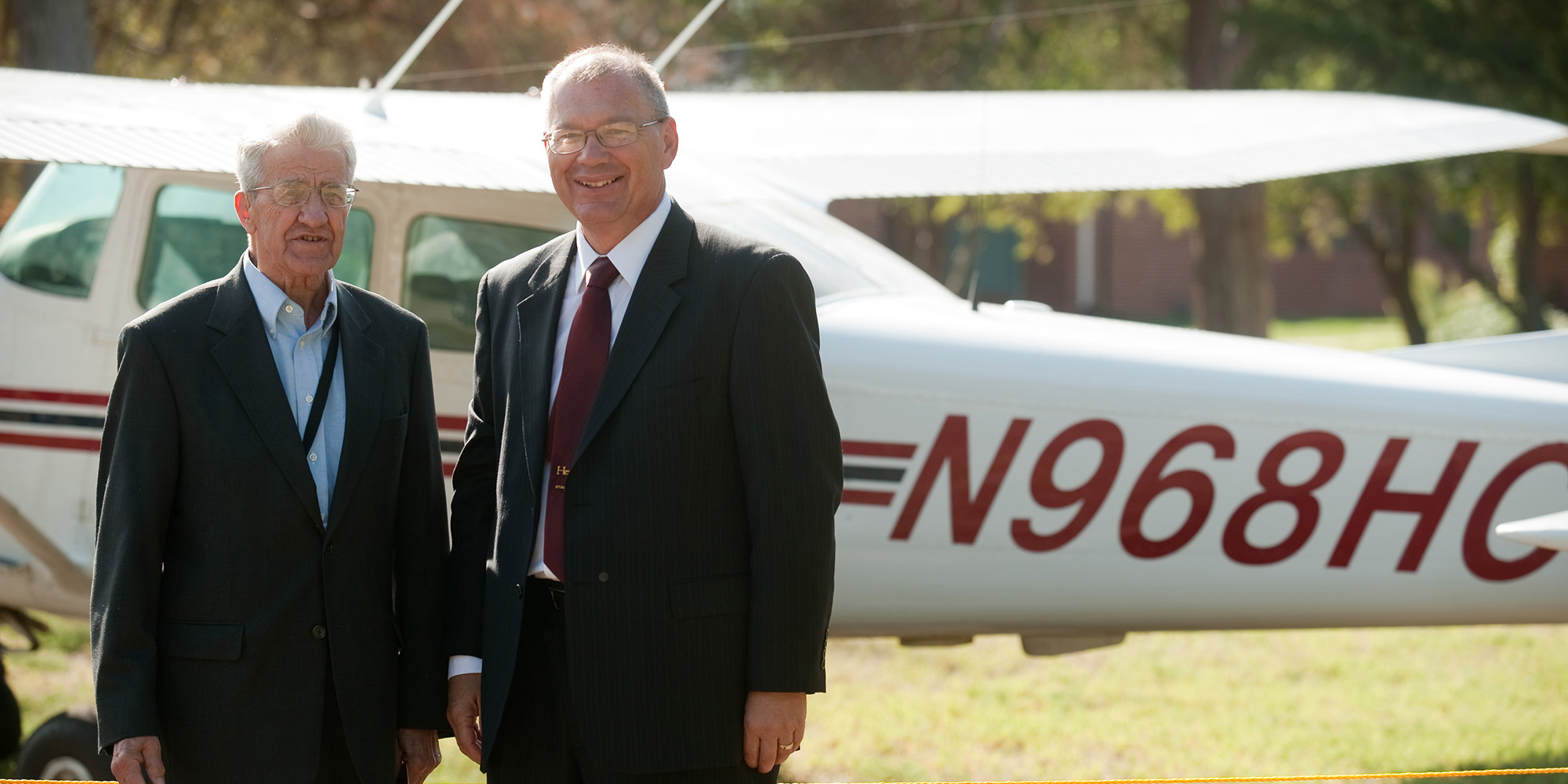
Aviation program remembers its roots
Aviation
Aviation has had a home at Hesston College for 41 years, and during the college’s annual homecoming celebration Sept. 23 to 25, a panel of former employees told the story.
Former President Laban Peachey of Harrisonburg, Va., (1960 to 1980)(pictured above with President Howard Keim) recounted the story along with former program directors Dave Forrer (Independence, Mo.), Jacob Friesen (Sun City, Ariz.) and Wendell Sauder (Hesston, Kan.). Vice President of Academics Dr. Sandra Zerger served as moderator.
The aviation program was launched at Hesston in the fall of 1970. Peachey recalled that the college had just revised its general education curriculum and wanted to implement more career options.
But the plan for aviation seemed unprecedented. How could a small Christian college support an Aviation program?
“We had no planes and no facilities; just a lot of interest and enthusiastic students,” said Peachey.
“Aviation at Hesston College worked early on because we had tremendous support from Laban and the Business Office,” said Friesen. “Their trust and support of the program allowed it to grow.”
During its first year of existence, the program leased an airplane from the Moundridge (Kan.) Flying Club, used the McPherson (Kan.) airport as its base and offered two courses – one ground training course and one flight training course.
With the rookie year complete, the program began to make strides toward what would become a highly successful program.
Forrer began as Director of Aviation in the fall of 1971 and began to look for ways to make the program take off. He recommended that the college invest in a plane, which it did in the fall of 1973 when it purchased a Cessna 150.
“We needed to establish credibility within the first few years,” said Forrer.
The next two years brought significant developments, building respect and validity for the fledgling program. Friesen arrived at Hesston in the fall of 1973 as a second instructor. That year, the program also received FAA approval, the fleet of airplanes grew from zero to three and the program’s base moved from McPherson to the Newton (Kan.) City-County Airport, where Friesen and Forrer set up office in a 20-foot trailer.
From that point forward, the program continued to grow in size and repute, though it was not without its low moments.
“There were times when the state of the economy and the aviation industry as a whole affected enrollment and interest in Hesston’s program,” said Peachey. “A lot of small aviation programs around the country folded, but we made it through.”
“Some circumstances were out of our control,” said Friesen. “We kept going during those times because of the students who were so determined to succeed.”
Director of Aviation Dan Miller, a 1978 graduate of Hesston’s program and Director since 1999, said fall 2011 enrollment boasts 45 students in the aviation program, including 12 studying Air Traffic Control, which was introduced at Hesston in 2009 and in 2010 became one of 36 colleges across the country and the only Kansas college to gain FAA approval.
A fleet of five airplanes and two simulators help students earn six licensures. Students start with their private pilot license and continue through commercial and certified flight instructor levels and earn an associate’s degree. Vast improvements in office space have also been made, as the college now operates the program from a rented hangar at the Newton airport.
To date, more than 500 pilots can claim a Hesston College start. During Homecoming weekend, 11 of them returned to campus as presenters at an aviation symposium.
Enrollment numbers, directors and technology have changed the program over the last 41 years, but the one thing that remains constant is the commitment to teaching new aviators the basics of airmanship.
“There were students who struggled through the program but who are good airline pilots now,” said Sauder. “They would likely have been dismissed from other programs, but our philosophy has always been to help the student who wants to fly.”
“Success inspires success,” said Peachey. “The success of students who have come through the program inspire it to continue for many years to come.”

(left) Jerry Holloman (left) and Jacob Gayer (right), members of the first class of Air Traffic Control graduates in 2011 work with Director of Aviation Dan Miller in the on-campus table model simulation lab. The table model and computer simulation labs give students a hands-on approach to learning the dynamics and demands of the air traffic control profession. Air Traffic Control is the newest addition to the 41-year old Hesston College Aviation program, becoming FAA certified in 2010; (right) Sophomore Aviation student Kush Lengacher of New Providence, Pa. goes through the pre-flight process.