

Yost recognition highlights Alumni/Community games at Hesston College
Athletics
General
Hesston College will host its annual Alumni/Community event on Saturday, Dec. 10, with women’s and men’s basketball games versus Region VI rival Johnson County Community College (Overland Park, Kan.) at 2 and 4 p.m. Following the conclusion of the women’s game, Lyle and Erma Yost’s gift of Yost Center to the campus community will be recognized. Admission is free to all.
The 2011-12 academic year marks the 30th anniversary of Yost Center, the college’s main gymnasium, which was made possible by a major financial gift from the Yosts. In August 1981, a groundbreaking ceremony was held for the 23,700 square foot facility. In November of 1982, Yost Center was dedicated on the eve of that year’s basketball season. Since then, Hesston College men’s and women’s basketball, as well as Larks Volleyball, have called Yost Center home.
Lyle, a 1931 Hesston Academy and 1935 Hesston College graduate, was founder, chairman of the board and CEO of Hesston Manufacturing Co., later known as Hesston Corporation. The internationally-recognized farm equipment manufacturing company was purchased by AGCO Corporation in 1991.
“Lyle and Erma Yost have provided vision and support for Hesston College over a span of decades,” said Yvonne Sieber, Hesston’s vice president of Advancement. “Their contributions have helped shape and greatly enhance the college and its mission.”
Activities during the game include autographs by the Hesston College basketball teams, halftime contests, free Larks buttons, a Pop-a-Shot game and spray-on tattoos.
“We hope this free event is a small way to say thanks for the support that is given to the college and its athletic programs from alumni and friends in the community each year,” said Director of Alumni and Church Relations Dallas Stutzman. “We’re thrilled that Lyle can join us on this special occasion.”
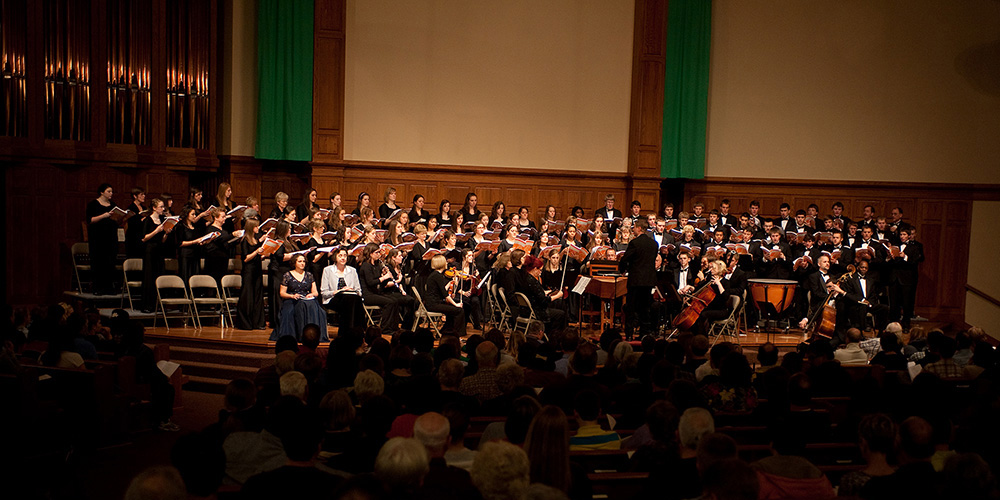
Photo release - Giving thanks at Hesston College - 2011 Thanksgiving celebration
General
More than 300 people, including 93 prospective students, descended on Hesston College for the 44th annual Thanksgiving Weekend Nov. 24 to 26. Activities for the weekend included a traditional Thanksgiving meal, music concerts, a talent show, men’s and women’s basketball tournaments and a two-mile run walk.
photo above - More than 80 voices combined with an orchestra of local musicians to present part one of Handel's Messiah on Thanksgiving evening at Hesston Mennonite Church.
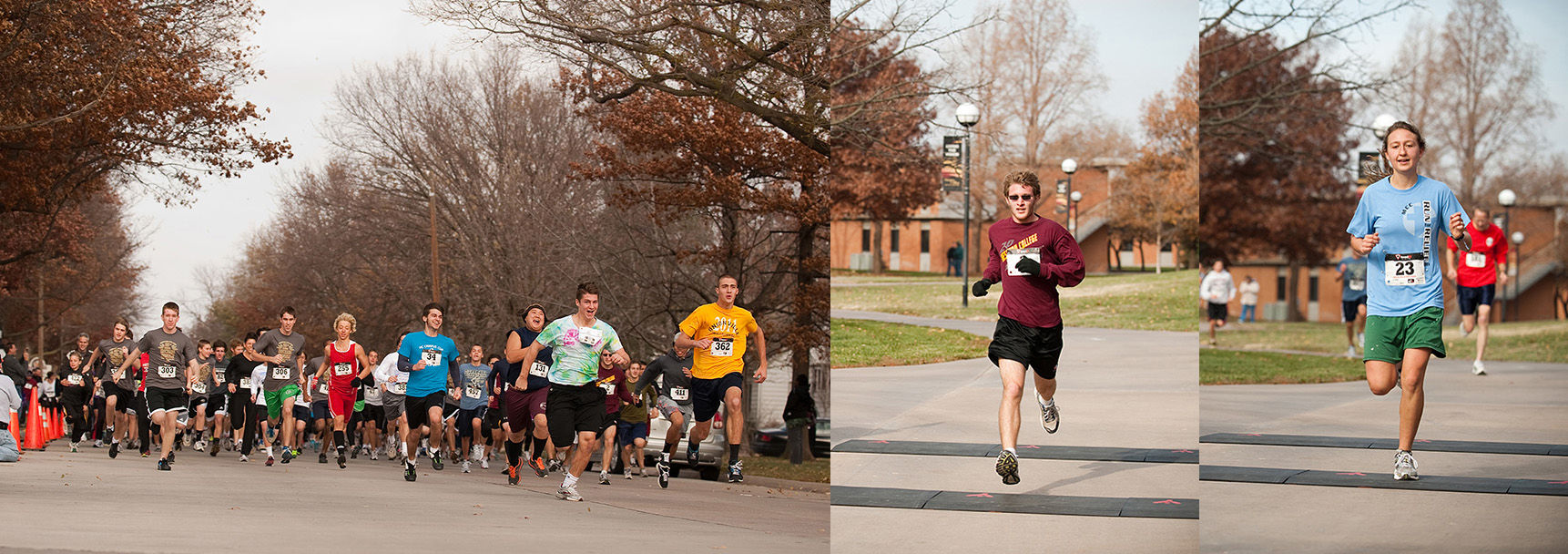
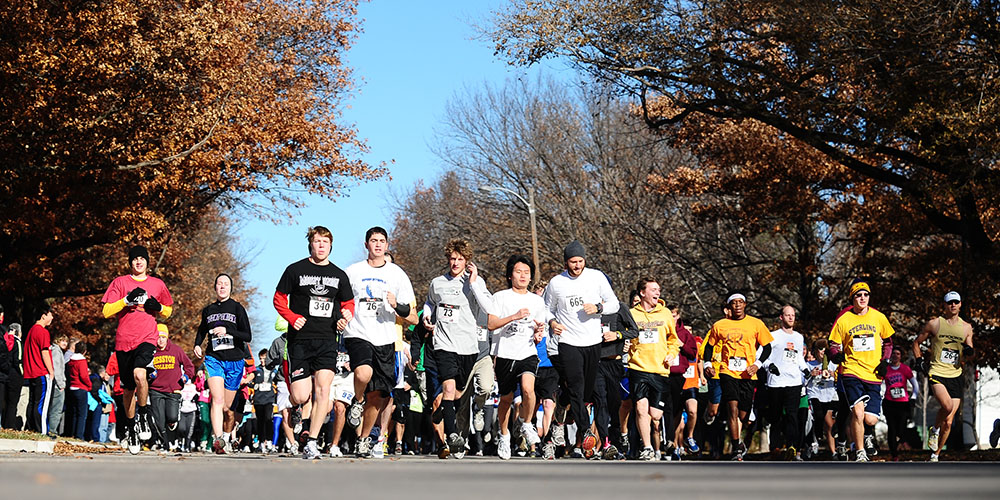
(left) Participants in the 20th annual Howard Hustle Two-Mile Run/Walk start the race with smiles on their faces. The special anniversary event had a record number 427 participants complete the route. Pictured in front from left are Jared Wedel (Hesston, Kan.), Joshua Troyer (Goshen, Ind.), Nick Woodward (Goshen, Ind.), sophomore Stephen Quenzer (Visalia, Calif.), sophomore Andrew Penner (Fresno, Calif.), freshman Matt Hershey (Harleysville, Pa.), and Tyler Denlinger (Perkasie, Pa.); (center) Freshman Jacob Landis (Sterling, Ill.), crosses the finish line during the 20th annual Howard Hustle Two-Mile Run/Walk. Landis, who is a member of the cross country team, finished the race as the top overall finisher and top male finisher with a time of 10:33; (right) Sophomore Krista Rittenhouse (Mount Pleasant, Pa.), crosses the finish line during the 20th annual Howard Hustle Two-Mile Run Walk. Rittenhouse, who is a member of the cross country team, was the top female finisher with a time of 13:08.
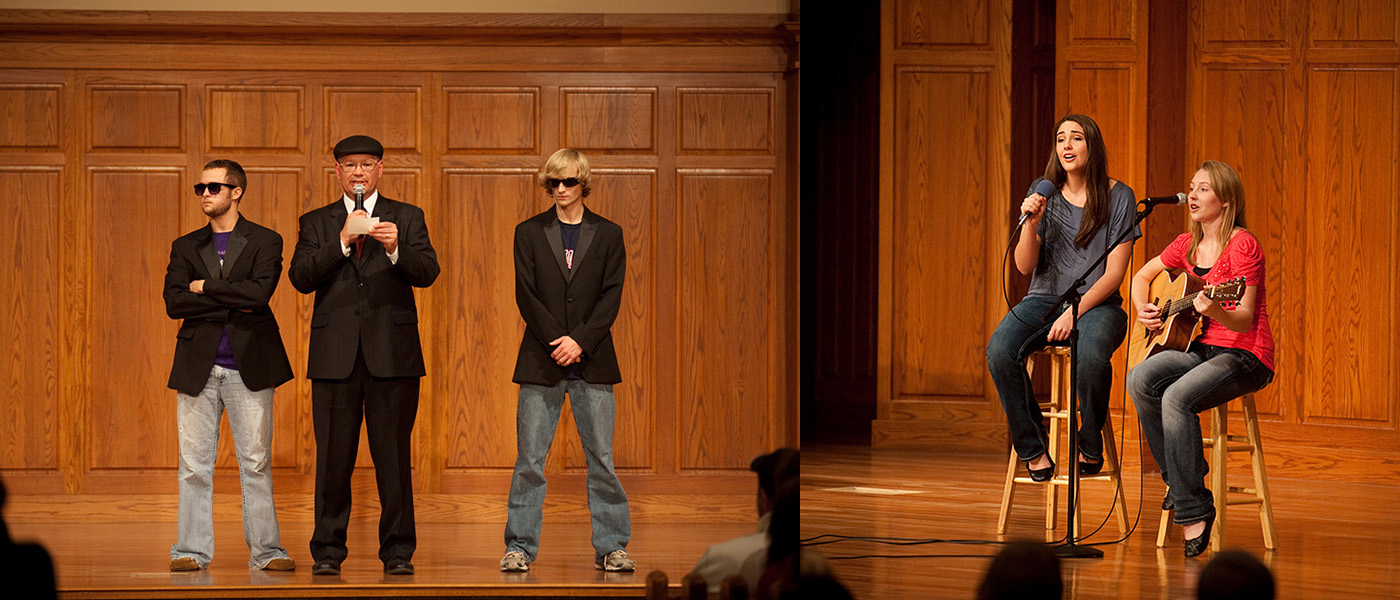
(left) Joel “Bill” Murray (Hesston, Kan.), and Brad “Bill” Sandlin (Valley Center, Kan.), act as President Howard Keim’s body guards as he introduces the next act at the talent show. Murray and Sandlin, are members of the student group “The Bills and Normas,” who are known for their antics around campus; (right) Sophomore Kara Stutzman (Hesston, Kan.), and freshman Rachel Miller (Hutchinson, Kan.) perform a song at the Talent Show.
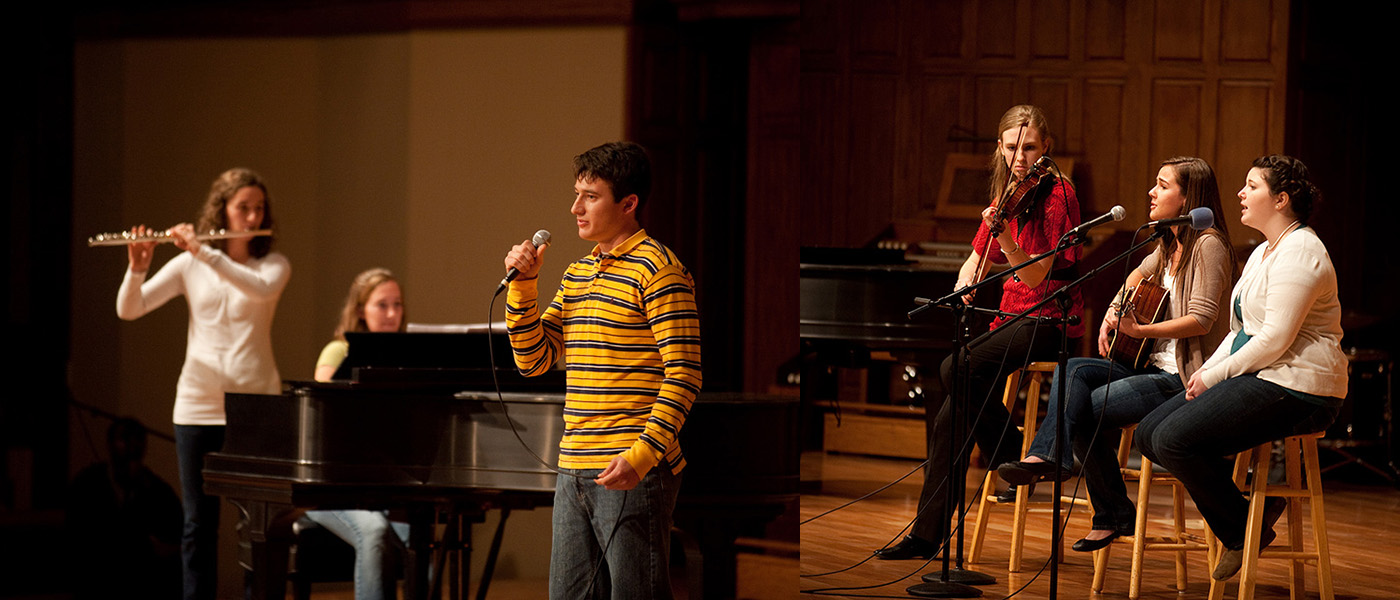
(left) Freshman Broxton Busenitz (North Newton, Kan.), performs a song during the Talent Show accompanied by sophomores Erin Hershey (Mechanicsburg, Pa.), and Katie Miller (Rio Rancho, N.M.); (right) freshmen Michaela Zook (Hesston, Kan.), Kaci Diener (Harrisonville, Mo.), and sophomore Melody Marshall (Grottoes, Va.), perform during the Talent Show.
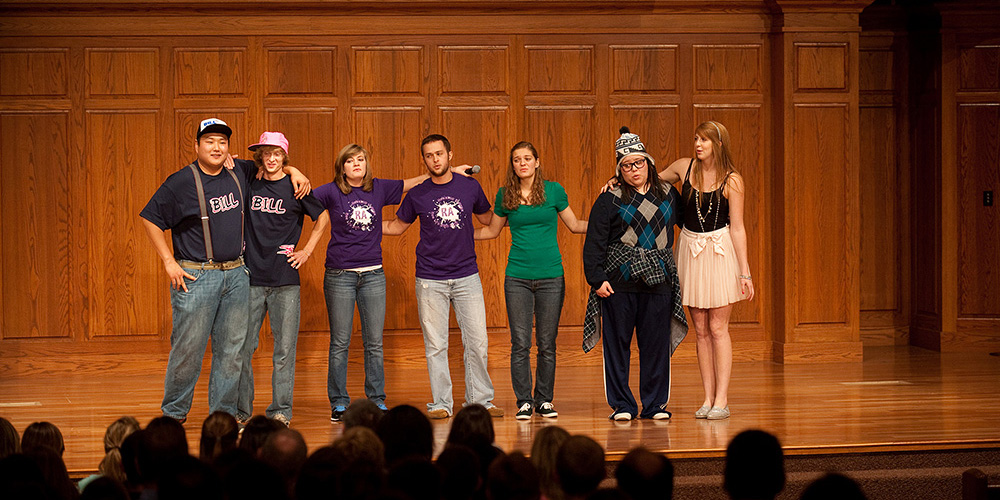
“The Bills and Normas” sing a parting song during the annual talent show. The group, made up of sophomores, hosts the talent show each year. Pictured from left are Andrew Penner (Fresno, Calif.), Brad Sandlin (Valley Center, Kan.), Kaedi LeFevre (Hesston, Kan.), Joel Murray (Hesston, Kan.), Hannah Bachman (Tiskilwa, Ill.), Rachel Brown (Inola, Okla.), and Kate Steury (New Paris, Ind.).
Prairie planting is fun for all ages
General
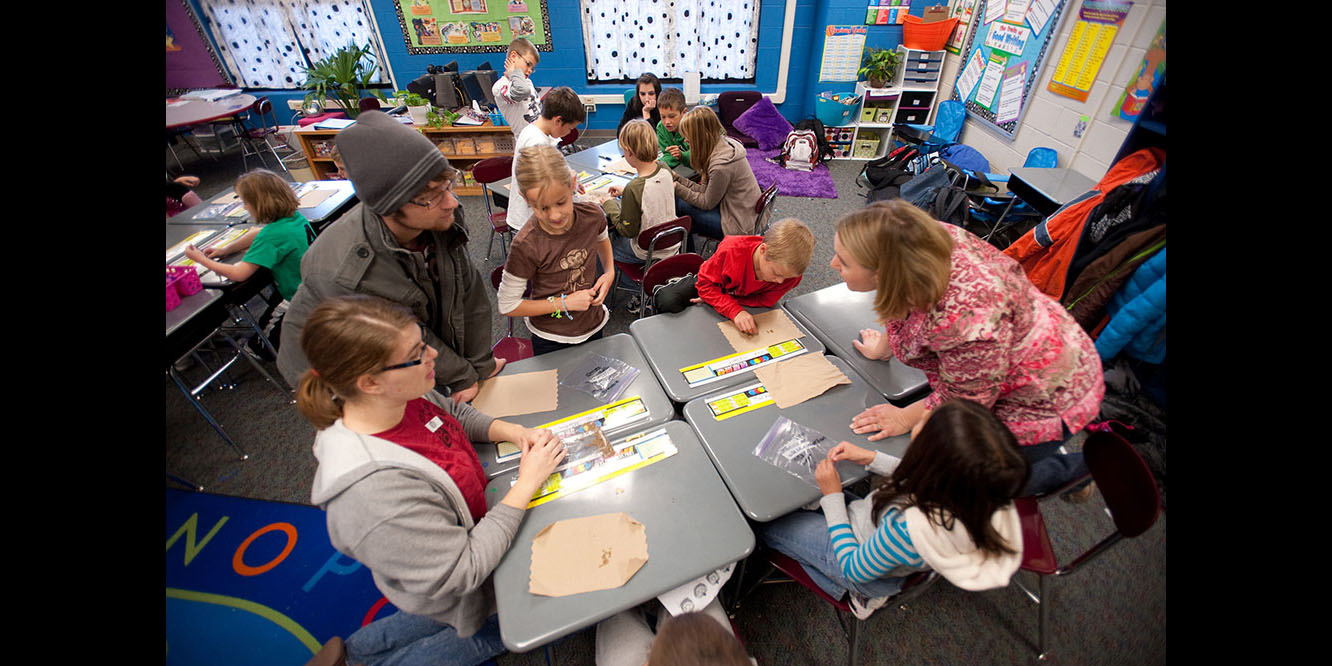
You won’t very often find elementary school students in a college class. On the same note, college students look funny sitting in chairs made for five-year-olds. Despite a divergence from the norm, Hesston College Environmental Biology students and kindergartners and third graders at Hesston Elementary School collaborated three times during the fall semester on a prairie plant project.
The idea for collaboration sprouted when kindergarten teacher DeDee Lehman and third grade teacher MeLissa Dryzmalla took a prairie restoration course at Dyck Arboretum of the Plains during the summer. One of the instructors was Hesston College biology faculty Lorna Harder. Dryzmalla and Lehman expressed their desire to do a prairie restoration project in their classrooms, and Harder offered her services.
Harder’s Environmental Biology class used three of their lab times this semester to meet with the elementary students to research prairie plants.
“I want my class labs to be meaningful and more than just an exercise,” said Harder. “This was a great opportunity for the college students to be a part of the learning process but also to help teach their younger counterparts.”
On one meeting the students did a plant scavenger hunt of prairie plants in the arboretum. Another project was a bug sweep, in which they observed and noted the native plants that attracted certain insects. For the final project together, the students harvested seeds from dead prairie plants and prepared them for simulated winter dormancy in a refrigerator.
“The kids have had fun working with the college students,” said third grade teacher MeLissa Dryzmalla. “This has given them a chance to learn how the prairie works, discover ways to protect and improve it and get to know each other.”
A group of third grade girls – Olivia Thompson, Elizabeth Lamp and Elly Morales – agreed that their favorite project in the process was looking for the different flowers and leaves during the scavenger hunt. Meanwhile, a table of boys – Cody Wohlgemuth, Jackson Humphreys, Landyn Stoltzfus and Isaiah Epp – reminisced about their favorite project – watching and chasing insects during the bug sweep.
“The college students help us out a lot,” said Thompson. “I like when we get to work with them.”
As the students carefully counted out seeds for each Ziploc bag – half in dry conditions, half in wet conditions – they made predictions and discussed which group would likely be more successful. Over the next several weeks, the students will observe how each set of seeds thrives in their conditions before planting them in their own prairie at the elementary school in the spring.
Much of Harder’s college course curriculum focuses on studying and understanding the local Kansas flora and fauna with hands-on projects and experiments. Other than their collaboration on the prairie restoration project, Harder’s students have helped install and maintain a rain garden at the Dyck Arboretum and have participated in the college’s community garden.
“I want my students to understand what it means to repair the earth, and I hope this project helps them see just what that means and entails,” said Harder. “I want Hesston College students to be agents of change.”
“Working with the elementary students on this project ties into what we do in class,” said Hesston College sophomore Amber Mayer of Wichita, Kan. “Concepts become easier to understand when we do lab projects that allow us to put the ideas to practice.”
As the Hesston Elementary School prairie begins to grow with native gayfeather, compass plant, coneflower, wild blue indigo and prairie dock, it will serve as a reminder for many students of the importance in preserving the land and collaboration.
Three students have success at vocal competition
Music
Three Hesston College voice students earned special recognition at the National Association of Teachers of Singing Regional Vocal Competition at Fort Hays (Kan.) State University Nov. 3 to 5. Twelve students represented Hesston College during the weekend competition.
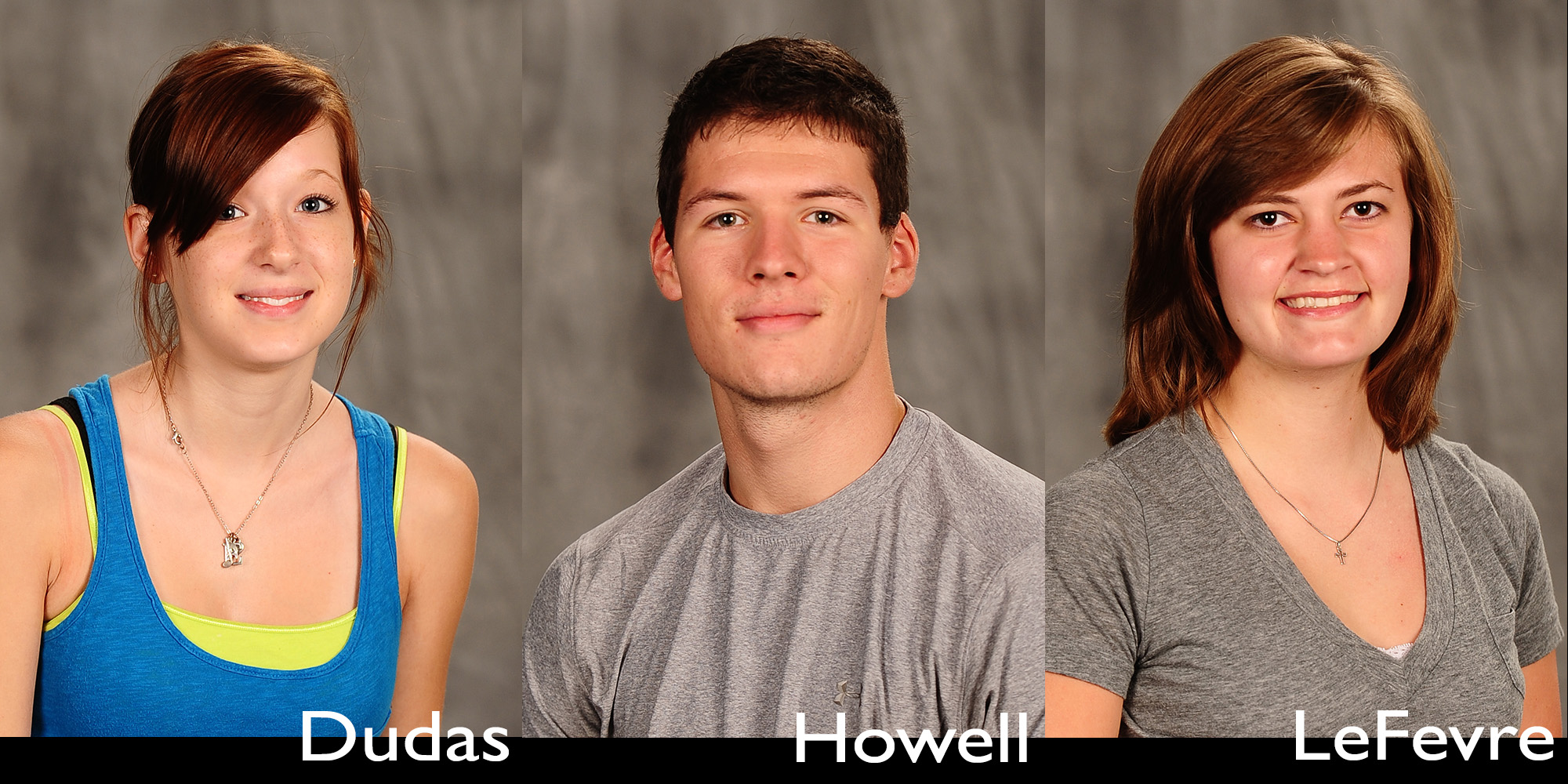
Freshman Emerencia Dudas of Toledo, Ohio earned second place in the Freshman-Sophomore Women’s Musical Theatre division, which was the highest finish for a Hesston College student since 2004. Sophomore Kaedi LeFevre of Hesston, Kan., advanced to the semifinal round in the Freshman-Sophomore Women’s Musical Theatre division and sophomore Robert Howell of Newton, Kan., was selected to sing at a musical theatre master class in front of other convention participants.
Dudas, Howell and LeFevre are voice students of Matthew Schloneger, Hesston College music faculty member, and are part of the college’s Bel Canto Singers, a 22-voice mixed chamber ensemble selected by competitive audition under the direction of Bradley Kauffman.
Other students competing for Hesston were freshmen Alex Bargerstock of Massillon, Ohio, Deni Brummer of Hutchinson, Kan., Broxton Busenitz of North Newton, Kan., Rachelle Hanna of Whitewater, Kan., Cameron Ponce of Elkhart, Ind., and sophomores Erin Banman of Lenexa, Kan., Michael Darby of Iowa City, Iowa, Melody Marshall of Grottoes, Va., and Katie Miller of Rio Rancho, N.M.
The NATS Vocal Competition pits students against one another based on their age level and gender. More than 300 students competed throughout the weekend, representing colleges and universities of all sizes from Kansas, Nebraska, Colorado and Wyoming.
“We had a very talented group of students this year and I thought everyone represented Hesston College well,” said Schloneger. “I am proud of the performances by all of our students.”
Hesston College prepares for Thanksgiving weekend 2011
General
A 44-year tradition continues at Hesston College’s annual Thanksgiving Weekend: A Family Celebration Nov. 24 to 26.
The weekend lineup includes activities for all ages, including a traditional Thanksgiving meal, music concerts, a talent show, men’s and women’s basketball tournaments, a two-mile run/walk and a luminary walk at Dyck Arboretum.
“Thanksgiving is a wonderful time for family and friends and particularly the Hesston community to join together for celebration,” said special events director Dallas Stutzman.
Rachel Swartzendruber Miller, vice president of Admissions, said the focus of the weekend is to give families of current students the chance to experience the Hesston College community. Prospective students and their parents can explore what Hesston has to offer and meet faculty during a majors exhibition, and enjoy the fun of the campus community during activities like the annual talent show.
“The weekend is a snapshot of what Hesston College is like,” said Swartzendruber Miller.
Some Thanksgiving weekend traditions of special interest include the traditional Thanksgiving buffet prepared by Hesston College Food Service and hosted by faculty and staff members. The dinner will be served from 5 to 6 p.m. Nov. 24 in Bontrager Student Center. Reservations are required.
The music department will perform several times throughout the weekend. A choral masterworks concert at 8 p.m. Nov. 24 in the Hesston Mennonite Church sanctuary will feature part one of Handel’s “Messiah” performed by an 80-voice choir of students and community members collaborating with an orchestra.
The Hesston College Chorale, Bel Canto Singers and Concert Band will perform works from their fall repertoire at 2:30 p.m. Nov. 25 in the Hesston Mennonite Church santuary.
Voice and Acting students will perform a collection of musical theatre songs and scenes during a Cabaret Music Revue at 4 p.m. Nov. 26 in the Northlawn Studio Theatre. Admission is free but tickets are required as seating is limited. Call the Hesston College Bookstore at 620-327-8105 to reserve tickets.
Current students, faculty and staff will display their talents through song, skits and video at a 10 p.m. talent show Nov. 24 in the Hesston Mennonite Church sanctuary.
The men’s and women’s basketball teams will host Brown Mackie College (Salina, Kan.), Tabor College (Hillsboro, Kan.) junior varsity, Northern Oklahoma College-Enid, Bethel College (North Newton, Kan.) junior varsity and Barton Community College (Great Bend, Kan.) for the American Family Insurance/Greg Raleigh Agency tournament Nov. 25 and 26.
The 20th Annual Thanksgiving Run – The Howard Hustle two-mile run/walk will be Nov. 25 at 11 a.m. An early entry fee of $15 is being offered to registrants until Nov. 16. The fee after Nov. 16 is $20. Entry fees cover t-shirts and a chip timer for each runner. Any remaining proceeds will be donated to The Hesston College Labyrinth Project. Individuals may donate a gift to the Labyrinth Project without participating in the run.
A complete weekend schedule and registration information can be found on the Hesston College website at www.hesston.edu or by calling the Special Events Office at 866-437-7866 or 620-327-8109.
Hesston College art gallery features Tabor College faculty
Art
Michael Phillips, art faculty member at Tabor College (Hillsboro, Kan.) is the latest local artist to have his works displayed in the Hesston College Friesen Center gallery. Phillips’ life-like drawings, paintings, clay work and wood sculptures will be displayed through Dec. 15.
A reception and chance for the public to meet the artist will be from 4 to 6 p.m. Nov. 17 in the gallery.
Phillips received his Bachelor of Fine Arts in painting and sculpture from the University of Kansas (Lawrence). He worked as an artist in Seattle for several years before attending Bible college and setting his art aside to work in ministry in Thailand for 20 years.
Phillips’ pieces reflect images of his life – landscapes, animals and people – in Kansas and Thailand.
In his artist’s statement, Phillips said the desire to create is something that has been a part of him since he was a young boy.
“At this time, I feel a need to spend more time working in the arts; it is certainly one of my greatest loves and gifts,” said Phillips. “As a couple, my wife and I plan on returning to Thailand to continue assisting in the works we have already birthed. We will also proactively work to build relationships with Asian artists and continue to show my art internationally.”
The gallery is open to the public from 9 a.m. to 4 p.m. Monday through Friday.
Thanksgiving tradition celebrates 20 years
General
Like most holiday celebrations, Thanksgiving Weekend at Hesston College is full of tradition. Each year, participants look forward to the talent show, music department performances and men’s and women’s basketball tournaments, not to mention the traditional Thanksgiving dinner.
One Hesston College Thanksgiving tradition that has grown in popularity among students, faculty, staff, community members, and out-of-town guests over the years is the annual run/walk, known for the past six years as the Howard Hustle. The 2011 celebration will mark its 20th year as part of the weekend lineup.
The run/walk was dreamt into existence by Jen LeFevre, who has served in multiple roles, including coach, physical education instructor and activities director, for 22 years. During her first Thanksgiving Weekend as a Hesston College employee, LeFevre realized the weekend provided ample time for guests to sit and little time for physical activity.
“I noticed how incredibly dormant people were during Thanksgiving,” said LeFevre. “We needed something active for people to combat all the sitting.”
So for her second Thanksgiving Weekend, LeFevre introduced a one-mile fun run on the day after Thanksgiving called the Mininger Mile, named for then interim president, Jim Mininger.
“You can find fun runs all over now, but people weren’t doing them back then,” said LeFevre. “It was a novelty to people, but I thought I could talk anyone into running one mile.”
And she did talk people into running one mile – she talked 29 of them into it.
Even with a meager turnout during the first year, the fun run became a staple Thanksgiving tradition on the Hesston campus.
Over the last 19 years, the event has grown, evolved, changed distances as it moved from one mile to a 5K before settling on the compromise of the current two miles, and even changed names as presidents come and go. For 10 years the run was called the Swartzendruber Sprint for Loren Swartzendruber, then spent two years as the Wiebe Wobblin’ and Gobblin’ for interim President Peter Weibe, and has been the Howard Hustle for Howard Keim since 2005.
In 2003 the existence of the run was threatened by budget cuts. Campus activities sponsored and organized the run, but as LeFevre said, it had become a “money pit,” and just didn’t seem like a feasible option. Yet the Admissions Department insisted the run was necessary as visiting prospective students, parents and families enjoyed the event.
All that was needed was someone to organize it. LeFevre’s Recreational Leadership class seemed like the logical choice as it allowed students practical, hands-on experience and the opportunity to complete an entire cycle of program development.
The class brainstormed ways to increase participation, including mod contests for students with the top finishing men’s and women’s mod winning free t-shirts for the entire mod and offering extra credit points to students in Fitness Concepts and Nutrition classes.
Their efforts paid off – literally.
“I went to the students and said, ‘We have a problem – the event is making money for the first time ever,’” said LeFevre. “We had to find something to do with it.”
The run has made money and been sustainable each year since with proceeds being donated to various causes. Gifts have been given to the Student Emergency Fund, to the Dyck Arboretum to assist in vandalism cleanup and purchased supplies and equipment for the new Friesen Center for the Visual Arts building.
This year, the money will go toward the construction of a labyrinth on campus.
“The labyrinth will work at improving mental, physical, emotional and spiritual wellness,” said LeFevre. “When you work your way through a labyrinth, you are encouraged to pray, meditate, brainstorm, or create – all things that positively impact many aspects of wellness.”
The 2010 Howard Hustle saw 425 participants cross the finish line – the most ever. LeFevre hopes that the 2011 run will have even more.
“This event is a way to get active, it gives students real life experience in event planning, and it is a good social event for families,” said LeFevre. “It’s fun to see the interaction that happens at the middle and back of the pack. College students who could easily run the race walk with their parents instead and spend those 30 minutes in dialogue. Board members, alumni and community members connect with current and prospective students and faculty and staff get to know students’ families.”
Jacob Landis, a Hesston College freshman from Sterling, Illinois will run the Howard Hustle for the third time this year. Landis placed second overall the last two years as a prospective student, finishing behind semi-professional triathlete Kevin Nickel from Newton, Kan. As the top runner on the men’s cross country team, Landis enjoys the good-natured competition with other returning runners and trying to improve from one year to the next.
“As a runner, I run races mostly just to race, but I have a great respect for all participants regardless of their ability or dedication to the sport,” said Landis. “The Howard Hustle is a great opportunity to get out and enjoy the community of Hesston with friends and family.”
The run will be at 11 a.m. Friday, Nov. 25. An early entry fee of $15 is being offered to registrants until Nov. 16. The fee after Nov. 16 is $20. Entry fees cover t-shirts and a chip timer for each runner, which are new for 2011 and will allow organizers to keep more accurate records. Any remaining proceeds will be donated to The Hesston College Labyrinth Project. Individuals may donate a gift to the Labyrinth Project without participating in the run.
Medals and a ceramic tile made by art faculty Hanna Eastin will be given to overall and age group winners, and all participants will have the chance to win door prizes.
For more information, to register for the run or to make a donation to the labyrinth project go to the Thanksgiving Weekend schedule on the Hesston College webpage at www.hesston.edu or call Jen LeFevre at 620-327-8277.
Former child soldier to share story with Hesston College community
General
Anywar Ricky Richard, a former child soldier from Uganda will share his story during Hesston College chapel at 11 a.m. Monday, Nov. 7 in the Hesston Mennonite Church sanctuary. Chapel service is free and open to the public.
Richard is a human rights and peace-building activist and educator who will speak about his experiences as a child soldier abducted into the Lord’s Resistance Army in Uganda at the age of 14, his escape, rehabilitation and reintegration to society.
After escaping the LRA, Richard received a degree in development studies from Kyambogo University (Kampala, Uganda) and a diploma in business administration from Uganda College of Commerce – Kabale. He worked with the Ministry of Education and Sports in Uganda at its headquarters in Kampala. He also serves as project advisor to community-based human rights organizations, working in the areas of peace building, income generation, health, education, arts and culture and economic development.
Richard founded Friends of Orphans in 1999, a social service organization based in Uganda that aids former child soldiers and sex slaves, abductees, orphans, child mothers and vulnerable women heading families. Richard has experience working with disadvantaged communities, war and HIV/AIDS affected communities and internally displaced persons.
In 2006, Richard founded the Anthony Brown Comprehensive School in Pader, Uganda, which educates former child soldiers and is named in honor of Hesston College faculty member and artist-in-residence and internationally acclaimed baritone Anthony Brown.
In 2009, Richard was honored by Free the Slaves, an internationally recognized anti-slavery organization, and awarded the Freedom Award: Harriet Tubman Reintegration Award for his work with social reintegration of survivors of slavery. Also in 2009, he received the Humanitarian Award from World of Children, an internationally recognized child advocacy group.
Richard serves as an Honorary Board Member of Peacing it Together Foundation, an organization that promotes peace and social justice through music and stories founded by Brown. Richard also serves as a member of the Board of Advisors of End Slavery Now, a U.S.-based organization that works with former slaves.
Richard will share his experiences Sunday, Nov. 6 with the Hesston Mennonite Church Sunday School classes at 9 a.m. and will speak briefly during the 10:30 a.m. worship service.
Renowned Russian quartet to bring classical sounds to HBPA concert
Music
The second Hesston-Bethel Performing Arts event of the 2011-12 season will feature the “blissful” sounds of the St. Petersburg Quartet on Bethel College’s Memorial Hall stage.
The string quartet, which is currently in residence at Wichita State University, will perform Sunday, Nov. 13, at 3 p.m.
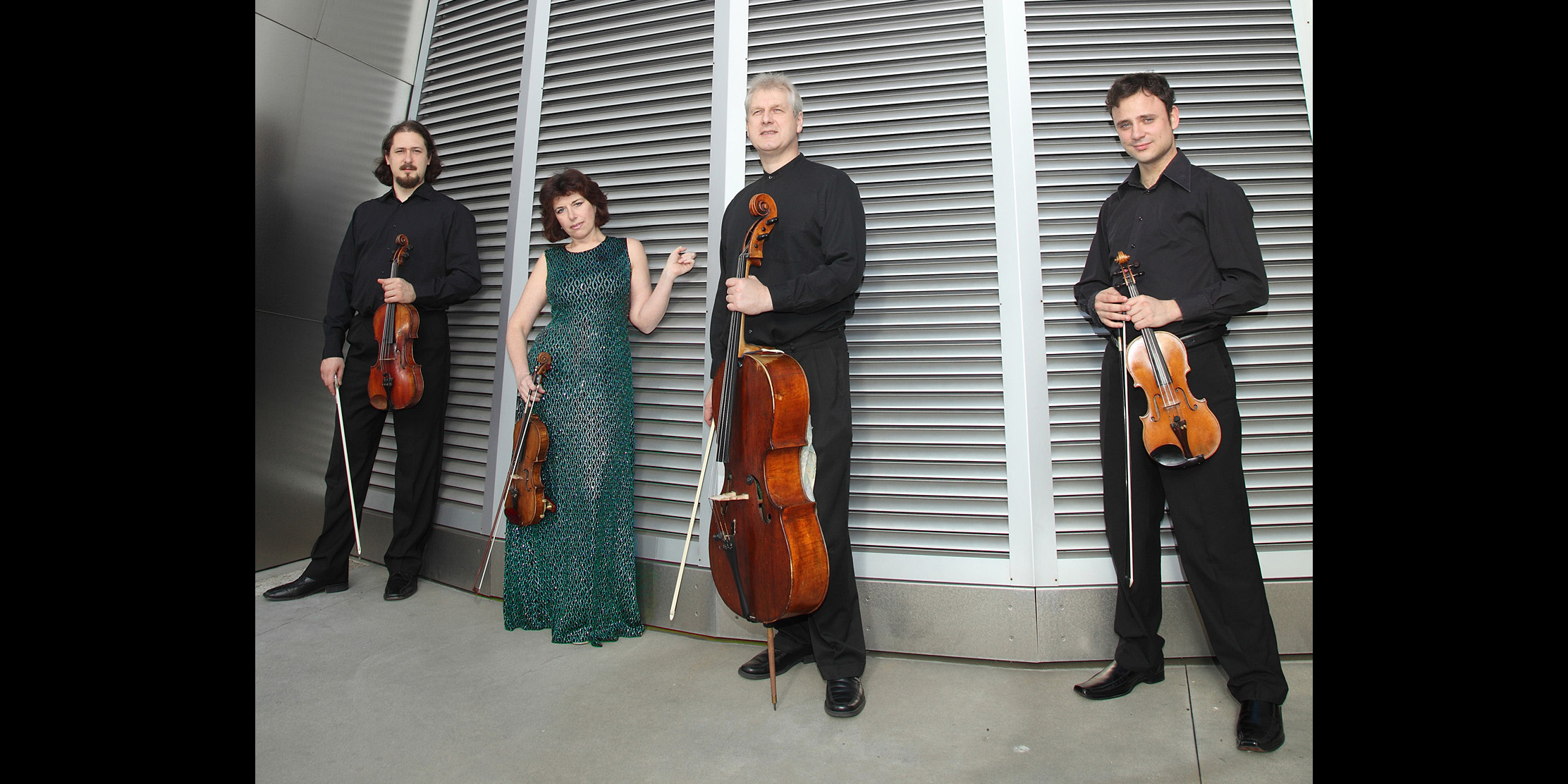
Quartet members are Alla Aranovskaya, 1st violin, Evgeny Zvonnikov, 2nd violin, Boris Vayner, viola, and Leonid Shukayev, cello. Aranovskaya and Shukayev are founding members of the SPSQ. Vayner joined in 2005 and Zvonnikov in 2010.
The St. Petersburg Quartet is one of the world’s most esteemed chamber ensembles. Some of its distinctions: a Grammy nomination; “Best Record” honors in both Stereo Review and Gramophone; an opening night performance at Mostly Mozart at Lincoln Center; a five-year residency at the Oberlin Conservatory of Music; and hundreds of concerts on and in many of North America, Europe and Asia’s most prestigious stages, series and festivals.
Highlights of recent seasons in North America include playing the opening concert of the Chamber Music Society of Lincoln Center quartet series (the New York Times praised the SPSQ’s “sumptuous account of Tchaikovsky’s Quartet No.1”); a collaboration with Van Cliburn gold medalist Olga Kern; a tour with violist Michael Tree of the Guarneri Quartet at the Library of Congress; three concerts at New York’s Metropolitan Museum with the late Ruth Laredo; and a 17-concert tour of Canada, during which a Toronto Globe and Mail reviewer wrote, “Bliss, for this listener, doesn’t get much more unequivocal than the St. Petersburg Quartet’s performance.”
The SPSQ has, in recent years, toured the Netherlands, Spain, Germany, Sweden, Denmark, Israel and the United Kingdom, where Tchaikovsky Piano Competition winner Peter Donahoe called their collaboration “some of the most sublime moments of chamber music-making I have ever experienced.”
Founded in 1985 as the Leningrad String Quartet, the SPSQ blazed a trail through chamber music circles, winning a number of prestigious international competitions including first prize at the All-Soviet Union String Quartet Competition; a silver medal and a Special Prize at the Tokyo International Chamber Music Competition; first prize and both Special Prizes at the Vittorio Gui International Competition for Chamber Ensembles in Florence; and first prize and the Grand Prix Musica Viva at the Melbourne International Chamber Music Competition. When the city of Leningrad resumed its historic name, the quartet changed its name to the St. Petersburg String Quartet.
In 2009, the SPSQ launched the St. Petersburg International Music Academy, an intensive summer program for students, which they bring to various campuses and festivals in the United States and Mexico. In 2010, the SPSQ was appointed the inaugural Quartet in Residence at WSU.
HBPA director Matthew Schloneger noted that while the SPSQ is performing regularly in Wichita this year, their Bethel program “will feature entirely different repertoire that Wichita audiences may not have heard.”
On the Nov. 13 program is Five Miniatures on Jewish Folk Themes by Sulkhan Tsintsadze (1925-91); the “Chaconne” from Partita No. 2 in D minor for solo violin by J.S. Bach (arr. Vayner); Beethoven’s String Quartet No. 11 in F minor, Opus 95, “Serioso”; and Tchaikovsky’s Quartet No. 2 in F major, Opus 22.
The latest releases in the SPSQ’s extensive discography include recordings of Ravel and Debussy quartets as well as Tchaikovsky’s complete chamber music repertoire.
For more about the musicians, a complete discography and other information, see the quartet’s website, www.stpetersburgquartet.com.
Single ticket prices for the St. Petersburg Quartet range from $15 to $18, depending on seating section, with discounts available to students and senior citizens.
For more information or to purchase tickets, call 316-284-5205 (Bethel College) or 620-327-8158 (Hesston College), e-mail hbpa@hesston.edu or visit the HBPA website at www.hesston.edu/hbpa.
Other concerts in the series include YouTube musical sensation Igudesman and Joo, traditional Irish music and dance rhythms with the highly acclaimed Celtic Crossroads and ancient choral music by the Rose Ensemble. Visit www.hesston.edu/hbpa for dates and times.
This program is presented in part by the cities of Hesston and North Newton, with generous underwriting by area patrons.
The Hesston-Bethel Performing Arts Series, now in its 30th year, started in 1982 as the Hesston Performing Arts Series (HPA) with funding and planning provided by Hesston College and the Hesston community. In 1998, HPA planners launched a partnership with Bethel College (North Newton) and the name changed to Hesston-Bethel Performing Arts. Hesston College and Bethel College host five performances by world-renowned or regionally acclaimed artists each year.