
General
Nursing
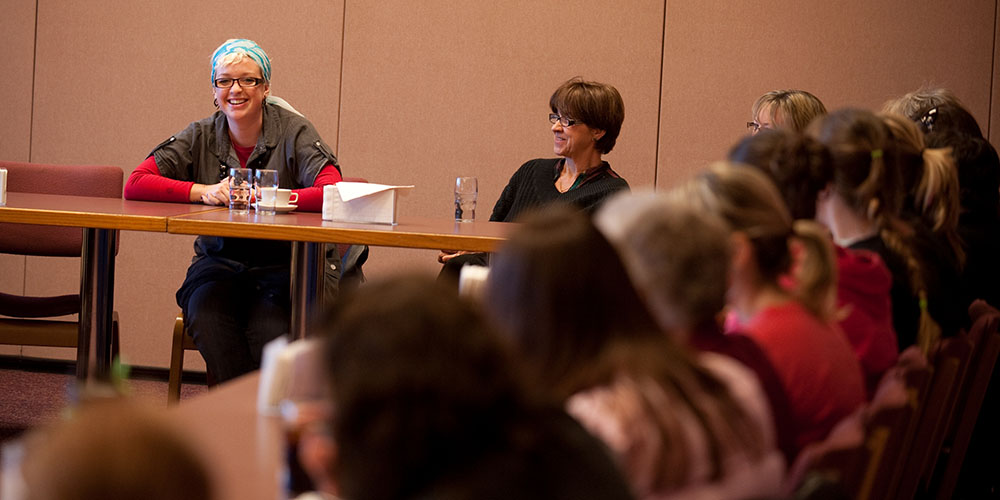
Rachel Neufeld has hiked in the Andes Mountains, lived in a London flat, traveled around Europe, paddled hollowed-out canoes into remote villages in Papua New Guinea and enjoyed the beaches of Australia. She’s tried ethnic foods and experienced cultures and histories all around the globe. Hearing about all of her adventures, one might wonder how she has time to work, but these adventures are her work.
As a traveling nurse and native of British Columbia, Canada, who got her start at Hesston College, Rachel fully embodies the college’s tagline of “Start here, go everywhere.”
“Hesston is the reason I can do what I do,” said Rachel. “As a travel nurse, you’re expected to know what you’re doing. You just show up and they throw you into a unit. Nursing care is universal. It comes from having a good base and an understanding of nursing fundamentals, and that’s what I received from Hesston.”
In her 10-year travel nursing career, she has lived in Philadelphia, Denver, Colorado Springs, Seattle, San Diego, Wolfpoint, Mont., London, Peru, Papua New Guinea and Australia. While the locations offer plenty of opportunity for travel and new experiences, her first commitment is to provide care for those who need it and to learn about the nursing field in different cultural contexts.
“I go where the wind blows, and the wind keeps changing direction,” said Rachel.
As a student at Hesston, Rachel kept a busy schedule, but found a balance between the intensity of the nursing program, playing on the volleyball team and participating in theatre productions.
“Volleyball and theatre were good outlets for the stress of nursing and all the heavy duty academics,” said Rachel.
Bonnie Sowers, Hesston College director of nursing, remembers Rachel as a creative and respectful student with a passion for the people around her and achieving her goals.
“Rachel was delightful to have as a nursing student,” said Sowers. “She was positive, engaging and a friend to all. Clinically, her patients and nursing staff also loved her.”
After earning a two-year associate degree in nursing from Hesston in 2001, Rachel got her Bachelor of Science degree in nursing from the University of Alberta (Edmonton, Alberta, Canada). She was drawn to the idea of new adventures every few months and began considering travel nursing as a career. She could contract with a hospital for three months and then move along to the next place, with new sites, foods and cultures to satisfy her curiosity.
“I flit around from hospital to hospital doing shifts in random units wherever they need me,” she said. “I’ve done high-drama nursing with trauma patients, worked in public health care and in hospice. The broader the experiences I can have, the better.”
The high adrenaline atmosphere of trauma nursing was where Rachel thought she felt most at home, until she landed an ongoing job at a hospice in London. The opportunity to explore other cultures’ approach to end-of-life care, to adopt some of those practices and incorporate them with the holistic approach to care she learned at Hesston is what helped Rachel fall in love with hospice work.
“Working in hospice changed the course of my career,” said Rachel. “I appreciate Hesston’s approach to holistic care. I have been shocked by the lack of empathy and sympathy I have heard from some nurses. Patients have told me they can tell a difference between nurses with holistic training and those who had a more medical approach.”
During her time in Australia, from December 2010 to November 2011, Rachel contracted with hospitals and a hospice in the northern coastal city of Darwin to maintain a balance of different skill sets.
“I made an effort to learn a culture’s view of death and dying,” she said. “I love to help people have the best process possible – to maintain dignity, reduce suffering and enjoy the time you have instead of fighting it.”
Not all of Rachel’s experiences have been in traditional hospitals or with traditional care. In 2008, she spent six months volunteering in Peru with Volunteer Abroad. Her first three months were spent in a remote, rural public health clinic in the Andes Mountains, followed by three months in a hospice in Lima providing care for patients with HIV and tuberculosis.
Part of her time in Australia was spent volunteering with Youth With a Mission. Based from an Australian medical ship, she was part of a team that set up temporary basic public health clinics in remote villages in Papua New Guinea.
“I never saw Rachel as someone who would want to be contained in a very prescriptive role, but she certainly understood protocol, structures and the need to be professional,” said Sowers. “She was creative, but not someone who wanted to rock the boat just because she could.”
Regardless of the setting or the culture, Rachel comes away with new ideas and a new perspective on what she thought she previously knew.
“Taking things from other cultures has shaped my view of medicine,” she said. “I would like to see a balance in Western care between medications and natural products. I appreciate the advances in Western medicine, but sometimes you just need a little tea.”
Rachel doesn’t know what she might encounter next, but she is confident Hesston College gave her a solid foundation to be prepared for whatever might come her way.
“I have encountered nursing students and nurses at other schools, but Hesston is, hands down, the best nursing program I have seen,” she said. “Clinicals start right away and correlate directly with classroom input. The standards are high, which forces hard work, but it’s allowed me to do what I need to do. It was totally worth the work.”
Hesston College to host Nehemi Chigoji as pastor in residence
Bible and Ministry
Hesston College will host Nehemiah “Nehemi” Chigoji of Upland, Calif., as pastor in residence March 19 to 21.
Chigoji, pastor of First Mennonite Church in Upland, brings experience working with diverse groups to the Hesston campus and wider community. His work includes ministering to an older Caucasian Mennonite congregation that has begun attracting young and ethnically diverse people from the neighborhood to the church. The congregation is also merging with an immigrant Indonesian congregation and shares worship space with a Spanish-speaking congregation.
Chigoji played professional soccer in Europe before being called to ministry. He has extensive cross-cultural experience, having lived in five countries on three continents. He is also involved as a Theme Planning Committee member for the 2013 Mennonite Church USA convention in Phoenix, Ariz.
As church leader in residence, Chigoji will connect with Hesston College students and local pastors. He will share his life story and work during chapel March 19 with “My Story: How God used sports, three continents and a mixed up marriage.” March 21 chapel will again feature Chigoji speaking on “How God can use your story to further His story.” Chapel is at 11 a.m. in the Hesston Mennonite Church sanctuary and is open to the public.
Local pastors are invited to take part in a free Church-College Conversations with Chigoji and Hesston College President Howard Keim beginning at 10:30 a.m. Monday, March 19. The schedule includes Hesston College chapel, lunch and discussion with Chigoji and a time to discuss and share about the Christian education of youth as they journey to adulthood led by President Keim. Pastors interested in attending the workshop should contact the Hesston College Church Relations office at 620-327-8109 or toll free at 866-437-7866.
Hesston College Chorale to present spring break concert in seven states
Music
The Hesston College Chorale will present its spring break tour concert celebrating the Lenten season in 10 churches and schools across Kansas, Nebraska, South Dakota, Minnesota, Wisconsin, Illinois and Missouri March 2 to 11.
- Friday, March 2 at 7:30 p.m. at Southern Hills Mennonite Church, 511 Southeast 37th Street, Topeka, Kan.
- Saturday, March 3 at 7 p.m. at Milford Mennonite Church, 920 3rd Street, Milford, Neb.
- Sunday, March 4 at 10:45 a.m. at First Mennonite Church, 12100 Adams Street, Lincoln, Neb.
- Sunday, March 4 at 7 p.m. at Salem Mennonite Church, 27844 443 Ave., Freeman, S.D.
- Monday, March 5 at 10:20 a.m. at Freeman Academy, 748 S. Main St., Freeman, S.D.
- Monday, March 5 at 7 p.m. at First Mennonite Church, 305 North 7th Street, Mountain Lake, Minn.
- Tuesday, March 6 at 7 p.m. at Madison Mennonite Church, (meets at Orchard Ridge United Church of Christ building) 1501 Gilbert Road, Madison, Wis.
- Thursday, March 8 at 7 p.m. at East Bend Mennonite Church, 702 CR 3300 N, Fisher, Ill.
- Friday, March 9 at 7 p.m. at St. Louis Mennonite Fellowship, 3752 Giles Ave, St. Louis, Mo.
- Sunday, March 11 at 10:30 a.m. at Sycamore Grove Mennonite Church, 5 miles north of Garden City, Mo., on Sycamore Grove Rd.
The concerts are free and open to the public, though a free-will offering will be collected to cover program costs. Hesston College alumni and friends are particularly invited to attend.
The 47-voice mixed chamber choir will be under the direction of Nathaniel Yoder, a 2010 Bethel College (North Newton, Kan.) graduate, who is filling in for director and music faculty member Ken Rodgers.

Hesston College deepens commitment to sustainability
General
Hesston College is now a member of the Association for the Advancement of Sustainability in Higher Education to further campus efforts toward building a healthy and just world. Through membership in AASHE, Hesston will receive support in advancing its sustainability initiatives throughout the institution and in the community.
“Hesston College has been active in sustainability efforts for a long time,” said Vice President of Finance and Auxiliary Services Don Weaver. “Sustainability is a core component of God’s call to us to be good stewards of all the resources we have been entrusted to manage. Joining AASHE is another step forward in accessing resources to continue to improve the ways in which we take care of our world.”
AASHE is an association of colleges and universities working to create a sustainable future by enabling higher education institutions to meet their sustainability goals through specialized resources, professional development and a network of peer support. Membership covers every individual at an institution, so the entire campus community can take advantage of member benefits.
“We are delighted to have Hesston College on board and participating in the campus sustainability community,” said Paul Rowland, executive director of AASHE. “This shows a real commitment to playing a leadership role in some of the biggest challenges of our time, and provides the campus community with access to thousands of examples of best practices in campus sustainability.”
AASHE hosts the Sustainability Tracking, Assessment and Rating System (STARS), a comprehensive campus sustainability rating system that enables institutions to measure their progress and learn from others. With STARS as a roadmap, institutions can select meaningful and appropriate pathways to sustainability while conserving valuable resources, combating climate change and building healthier communities. AASHE also offers extensive online resources and discussion forums for professional development and sharing knowledge.
AASHE is one of two supporting organizations for the American College & University Presidents’ Climate Commitment. More than 670 presidents and chancellors from institutions across the country have committed to lead their institutions to climate neutrality as soon as possible.
Hesston College placed extra focus on issues of sustainability for the 2011-12 academic year led by efforts from the First Year Experience seminar and a campus-wide common read “No Impact Man” (Picador, 2010) by Colin Beavan.
In September, the college observed its first No Impact Week, with daily presentations and activities relating to certain aspects of sustainability, including consumption, trash, transportation, food, energy and water. The week of events was an opportunity for the campus community to experiment with sustainable living and care of the environment on campus and as individuals.
A Campus Stewardship Group made up of Hesston College students, faculty and staff was formed during the fall 2011 semester to continue conversations about campus sustainability practices and to explore ways to decrease the college’s carbon footprint.
“The group serves as a place for those with an interest in sustainability to discuss and explore ways Hesston College can continue and improve on sustainability practices already in place,” said chair Gerry Selzer. “We want to bring awareness and education about sustainable practices to the rest of campus, and be supportive of ideas to accomplish those goals.”
Hesston College fundraising for dorm renovation a success
General
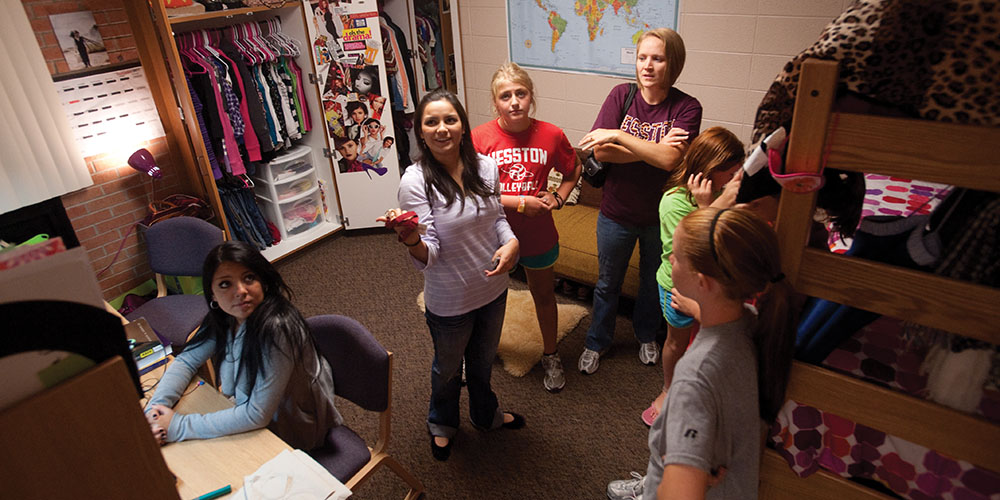
Hesston College Vice President of Advancement Yvonne Sieber announced that the college reached its nearly $3 million goal for renovations to the central and west wings of Erb Hall dormitory. The college will complete the renovations by adding an elevator and lounges connecting the separate wings of the building.
Work on the lounges is slated to begin once students move out following graduation in early May and will be completed by the time students return to campus in mid-August. The elevator is expected to be completed in 2012.
Local businesses and individuals gave generously to the Erb Hall Renovation Project, reflecting the community support for the college. Many of the college’s alumni and friends from around the country also added to the fundraising efforts to help update the space and improve the student experience.
“During these difficult economic years, we appreciate the help we received from the local community, alumni and friends of the college to give our students updated living spaces,” said Yvonne Sieber, vice president of Advancement. “We are glad we were able to renovate our existing dorms to maximize space and efficiency instead of constructing brand new buildings.”
About 75 percent of the college’s nearly 470 students live on campus. The student population represents 27 states and 14 countries, and for many students, Hesston College becomes a home-away-from-home for about nine months every year, giving an added boost to the local economy.
“Quality dorms help attract students who then spend money locally and help keep the college operating, providing jobs and more money flow in the community,” said Don Weaver, Hesston College chief financial officer and vice president of finance and auxiliary services.
Renovations in the central and west wings of Erb Hall have been ongoing over the last several years as the building, which was constructed in 1969, was beginning to show its age. A new roof and windows were installed in 2007. Bathrooms were renovated during summer 2010 followed by the dorm rooms and lounges in summer 2011. Renovations to the interior of the building included new paint, carpet and furniture, as well as replacing all mechanical infrastructure, rusted pipes and new heating and cooling units.
“We want our dorm spaces to be comfortable, pleasant and meet the needs of our students,” said Lamar Roth, vice president of student life. “Inviting spaces have a tremendous impact on student interaction. These renovations reflect how we want to present ourselves and the experience we provide”
Enough funds were raised by May 2011 to renovate the dorm rooms and mod lounges, which were completed in August 2011. The elevator and connector lounges were put on hold until additional funds were brought in. The college views the addition of the elevator as an important part of the project as it will make all four floors of the building accessible to all students.
“The elevator is an important element because it will expand accessibility for students who may be physically challenged – whether it is something they live with every day or temporarily for those recovering from injuries, broadening the residential experience and opening doors for social interaction,” said Roth. “It’s also important for our students to know they don’t have to worry about deteriorating pipes and that they have comfortable spaces in which to live.”
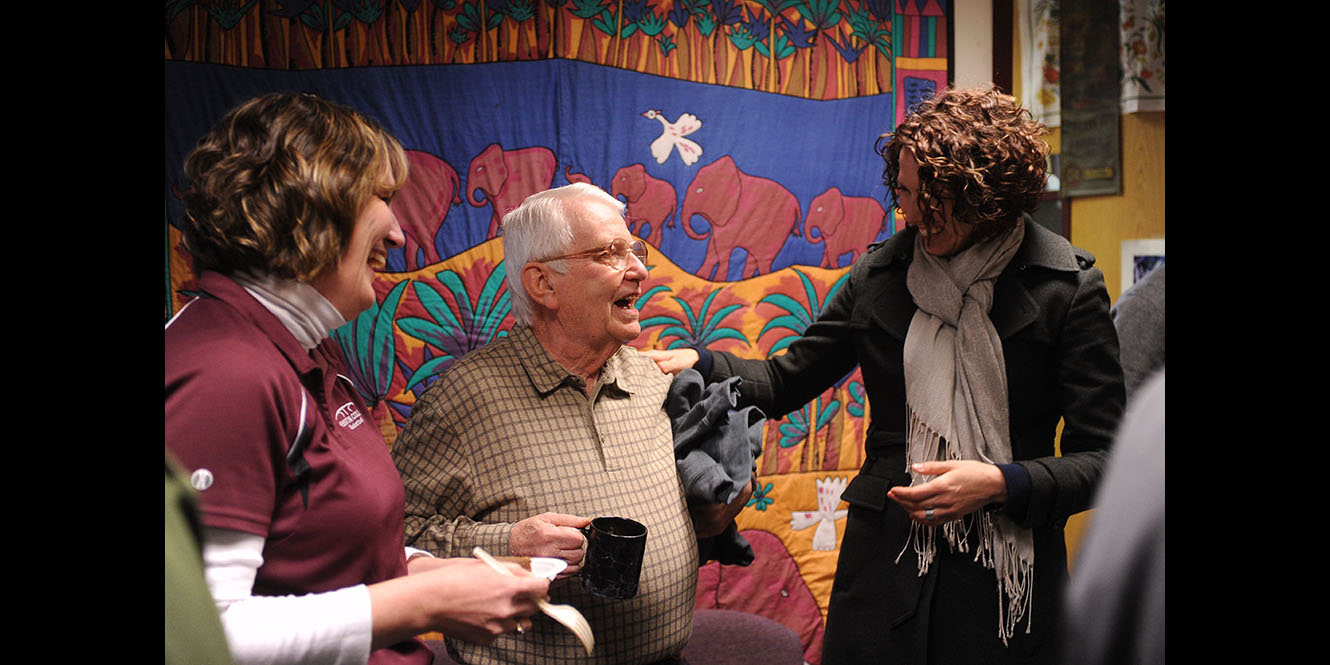
Photo release - Hesston College celebrates business instructor’s years of service
Business
Bill Mason (center), longtime Hesston College employee, is congratulated by Melissa Unruh (left) and Rachel Swartzendruber Miller (right) during Mason’s retirement celebration at Hesston College Feb. 16. Mason served at Hesston for 28 of the last 41 years in roles including public relations, student services, admissions and as a business instructor. He ended his time at Hesston following the fall 2011 semester. His background, professionalism and knowledge of the business world made him a valuable resource to the campus and his students. “Bill brought his rich experiences from the business world into the classroom and used his connections to provide valuable learning experiences with local businesses and at Mennonite Economic Development Associates conventions,” said Vice President of Academics Sandra Zerger. In 2010, The Bill Mason Business Scholarship was established to award four selected business students with a one-year, $2,500 scholarship for their sophomore year at Hesston College.

Hesston College art gallery features alumnus Dave Foncannon
Art
Hesston College will welcome back one of its own – Dave Foncannon – as the featured artist in the Friesen Center gallery Feb. 26 to April 13. Foncannon will display his alabaster sculptures.
A reception and chance for the public to meet the artist will be from 2 to 5 p.m. Feb. 26 in the gallery.
Many of Foncannon’s sculptures – with trademark qualities such as unfinished surfaces and edges and highlighting attributes of the stone – reflect the idea of the journeys through life.
“I think of carving each piece as a journey,” said Foncannon. “I carve intuitively, meaning I don’t come to the piece with a shape or subject in mind. Unfinished parts are reminiscent of natural growing edges in our lives. Tool marks and broken edges are like the marks we carry through life.”
Foncannon, of Limon, Colo., is a man of many talents. Aside from his art, he is also a songwriter and mandolin player for the bluegrass band Fireweed and recently ended an 18-year position as pastor of Pueblo (Colo.) Mennonite Church.
He received an associate of arts in Bible from Hesston College, double majored with a bachelor of arts in Bible and Religion and art from Bethel College (North Newton, Kan.) and earned a master of divinity degree from Associated Mennonite Biblical Seminary (Elkhart, Ind.).
The gallery is open to the public from 9 a.m. to 4 p.m. Monday through Friday.
Hesston College to host Arizona golf benefit for student scholarships
General
Hesston College will host its third annual national golf benefit March 10 at The Legend at Arrowhead in Glendale, Ariz., to raise money for student scholarships. Hesston College alumni and friends of the college are invited to participate in the golf tournament and other weekend activities.
The four-person scramble tournament features play on the premiere Legend at Arrowhead course, designed by golf legend Arnold Palmer, and raffle prizes, including a top prize of a Masters Golf Tournament package for two to the 2012 tournament April 5 to 8 in Augusta, Ga. The package, valued at about $8,000, includes round-trip airline tickets, three nights lodging, breakfasts and evening receptions and tickets for the practice round and opening round.
Raffle tickets are available to anyone regardless of participation in the golf tournament, and individuals do not have to be present to win. Tickets for the top prize are $10 per ticket or 15 tickets for $100 for people participating in the golf benefit and $10 per ticket or 12 tickets for $100 for people not golfing in the benefit.
Other raffle prizes include a Barrett Jackson 2013 car auction VIP package in Scottsdale, Ariz., valued at $3,500, TaylorMade Burner 2.0 clubs valued at $1,500, an Arizona golf package for four for golf at three area courses valued at $1,500 and an Arizona sports package including autographed jerseys of Kurt Warner and Larry Fitzgerald valued at $1,200. Raffle ticket prices for these prizes is $5 per ticket or five tickets for $20.
“The golf weekend is always fun and a good way for people from around the country to reconnect while also supporting Hesston College,” said Development Officer and event coordinator Larry Martin. “Steve Yoder and his daughter Amber Yoder (Phoenix, Ariz.) work hard to find exciting prize donations. No one leaves empty handed.”
Prizes will also be given for first through fourth places as well as the men’s and women’s longest drive and men and women closest to the pin. All participants will receive door prizes of gift cards ranging from $5 to $50.
The tournament entry fee for a team of four is $450. Individuals may also register for $125, and will be placed in a foursome. The entry fee covers green fees, golf carts equipped with a GPS unit for scoring, range balls and a barbecue dinner. Individuals or businesses can sponsor a hole for $250 and receive advertisement for their sponsorship.
For questions or to register or buy raffle tickets, call Amber Yoder at 623-412-2220 or email ayoder@nationalmallfront.com.
Hesston has maintained a presence in Arizona during the college’s week of spring break for many years as it is the annual spring break destination for the baseball team. The team plays at 6 p.m. March 5 at Phoenix College, 5 p.m. March 6 at Arizona State University (Phoenix), 2 p.m. March 8 at Mesa Community College, 6 p.m. March 8 at Gateway Community College (Phoenix) and 12 p.m. March 9 at Arizona Christian University (Phoenix).
President Howard Keim will preach at Trinity Mennonite Church (Glendale) at the 9 and 10:30 a.m. services March 11. Alumni and Church Relations will host a gathering for alumni and friends at the Los Angeles Dodgers versus Chicago Cubs spring training game at Camelback Ranch (Glendale) at noon, March 11. Tickets are $20 for adults and $5 for children 12 and younger. Reservations are required and can be made by calling Hesston College Alumni and Church Relations at 866-437-7866.
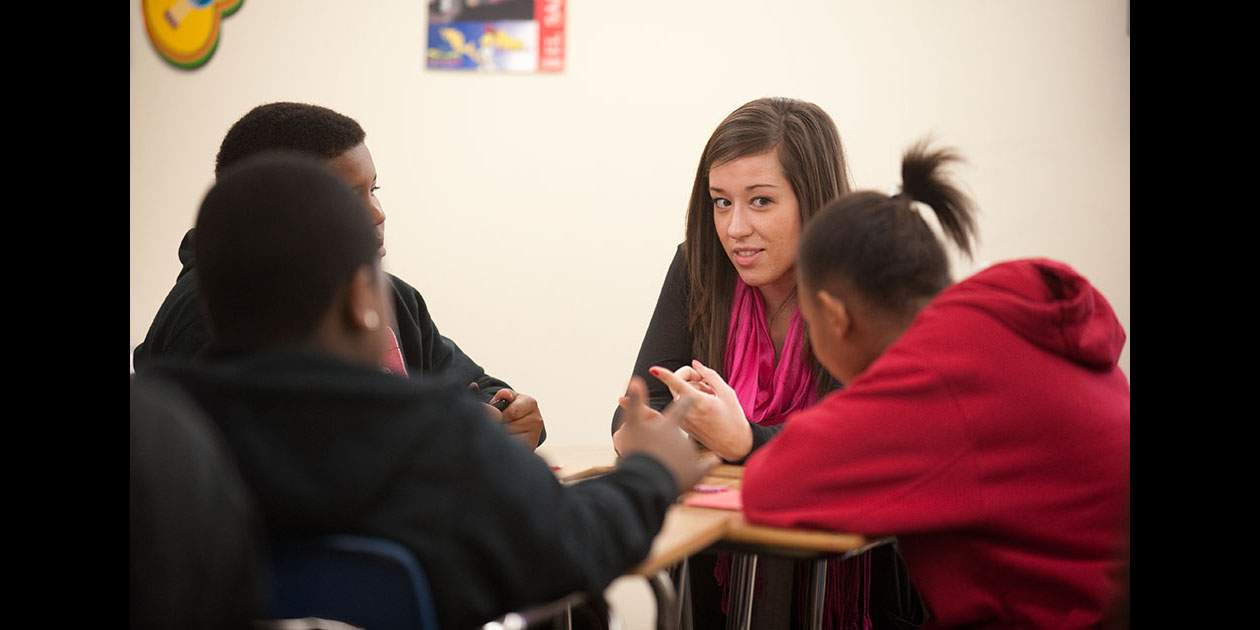
Education majors learn lessons of inequality
General
Hesston College students saw how different education can be from one place to another after spending a day in a Tulsa, Okla., high school.
Hesston education professor Marissa King took a group of 24 education majors to Central Junior High and High School Feb. 14 to experience a school that, for most of her students, was a new environment.
“I want my students to have tangible experiences, to explore their interests and build skills,” said King. “For many students, this trip was cross cultural. We were looking at a school that is incredibly diverse and in an urban setting. The problems and issues are much different than those an affluent school may face.”
Hesston students are used to observing in classrooms in the fairly affluent and rural school districts of Harvey County, Kansas, and most of them come from similar educational experiences. Central provided an opportunity to see education at work in a low economic, inner-city area where school is often not a top priority.
Central is classified as a Title I, Needs Improvement School because it has failed to meet the requirements of standardized testing set by No Child Left Behind. Following the 2010-11 year, the school, which is also a magnet school for fine and performing arts, was one of 28 throughout the city in danger of being shut down due to low enrollment and poor performance.
“Central is one of the roughest high schools in the city,” said Central English teacher Sadie Stockdale. “Most of the kids have never been given the tools they need to believe that they can be successful in life. They come from low-income homes and are involved with gangs. They believe prison is more of a reality than college.”
Central’s atmosphere and historically low student performance rates seem to have a direct correlation with high teacher turnover rates and a lack of adequate leadership from the district, which allowed Hesston students to see first-hand the effects of education inequality.
“The day was an eye-opening experience,” said freshman Bonita Garber of Bainbridge, Pa. “The level of inequality in education because of economic status is mind blowing. No one ever believed these students could make anything of themselves, so they don’t believe it either.”
Several of the teachers at Central, including Stockdale, work through Teach for America, a national organization that places teachers in impoverished areas with the belief that all students – regardless of race or economic status – deserve a high quality education. Teach for America educators join the program as recent college graduates and typically display strong leadership potential. King taught first grade for three years in Phoenix, Ariz., with Teach for America before joining the Hesston faculty for the 2011-12 year.
Teach for America states that only eight percent of kids growing up in low-income communities graduate from college by age 24. Stockdale and her colleagues work hard at Central to change the perceptions students have of themselves.
“High expectations mean a lot to kids,” Stockdale told Hesston students. “Meeting them where they are at instead of giving up when they don’t quite make it and knowing how to manage your classroom are the two biggest attributes a successful teacher can have.”
Hesston students had the opportunity to see classrooms and teachers in action as well as put their own skills to work by participating in the action. They spent the day observing in classrooms, doing class presentations about preparing for college and working in small groups with the high school students to review the standardized test objectives that need the most improvement.
“Teachers must develop diversity competencies in order to effectively serve all students,” said King. “This trip was a chance for students to connect theory and research to action.”
For sophomore Brocia Beachy of Wolcottville, Ind., the day was glimpse into what she might be able to expect as she moves on from Hesston following graduation in May. Beachy plans to spend next year gaining more experience in diverse and low economic areas by volunteering with the Hopi Mission School on the Hopi Reservation in Kykotsmovi, Ariz.
“This year, Marissa and my education classes have helped me discover a passion for teaching and how much I care about kids,” said Beachy. “Being at Central made it evident to me that it makes a big difference when teachers care about their students. It was interesting to see different teaching styles and how students respond to them.”
Central teachers thought the experience was good for their students as well as the college students.
“It is good for the kids to get one-on-one interaction with college students,” said English teacher Matt Gress. “It gives them a chance to see what college could be like and hopefully encourage them toward that path as well.”
Despite some initial concerns from the college students about knowing how to engage the students, they came away with a greater understanding of the struggles that are a reality for so many schools, teachers and students in urban and low-income areas throughout the country.
For Beachy, it was added fuel to serve where she is most needed.
“I want to make a difference for kids wherever I might end up,” she said. “I don’t want to just go where it is easy and always comfortable.”
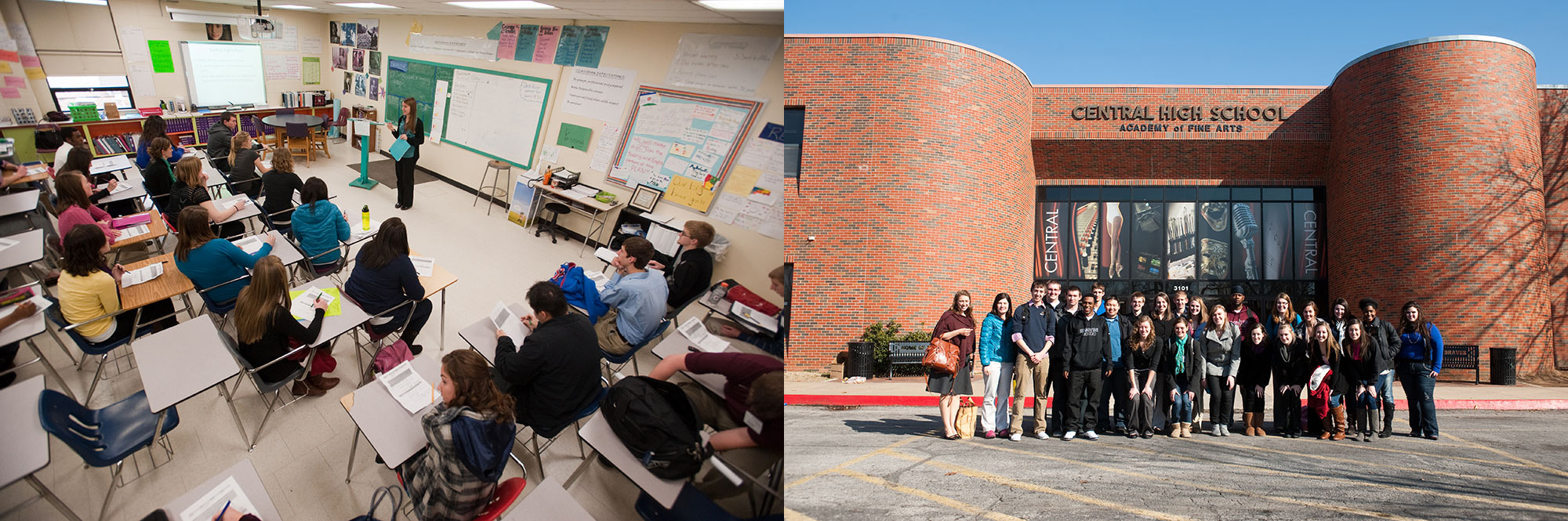
(left) Sadie Stockdale gives Hesston College education students an introduction to Tulsa Central Junior High and High School; (right) the Hesston College group poses outside Tulsa Central Junior High and High School after their day of observing and working with students.