
Mennonite World Conference president-elect to headline 2013 commencement
General
Hesston College will celebrate the class of 2013 during Commencement Weekend May 3 to 5.
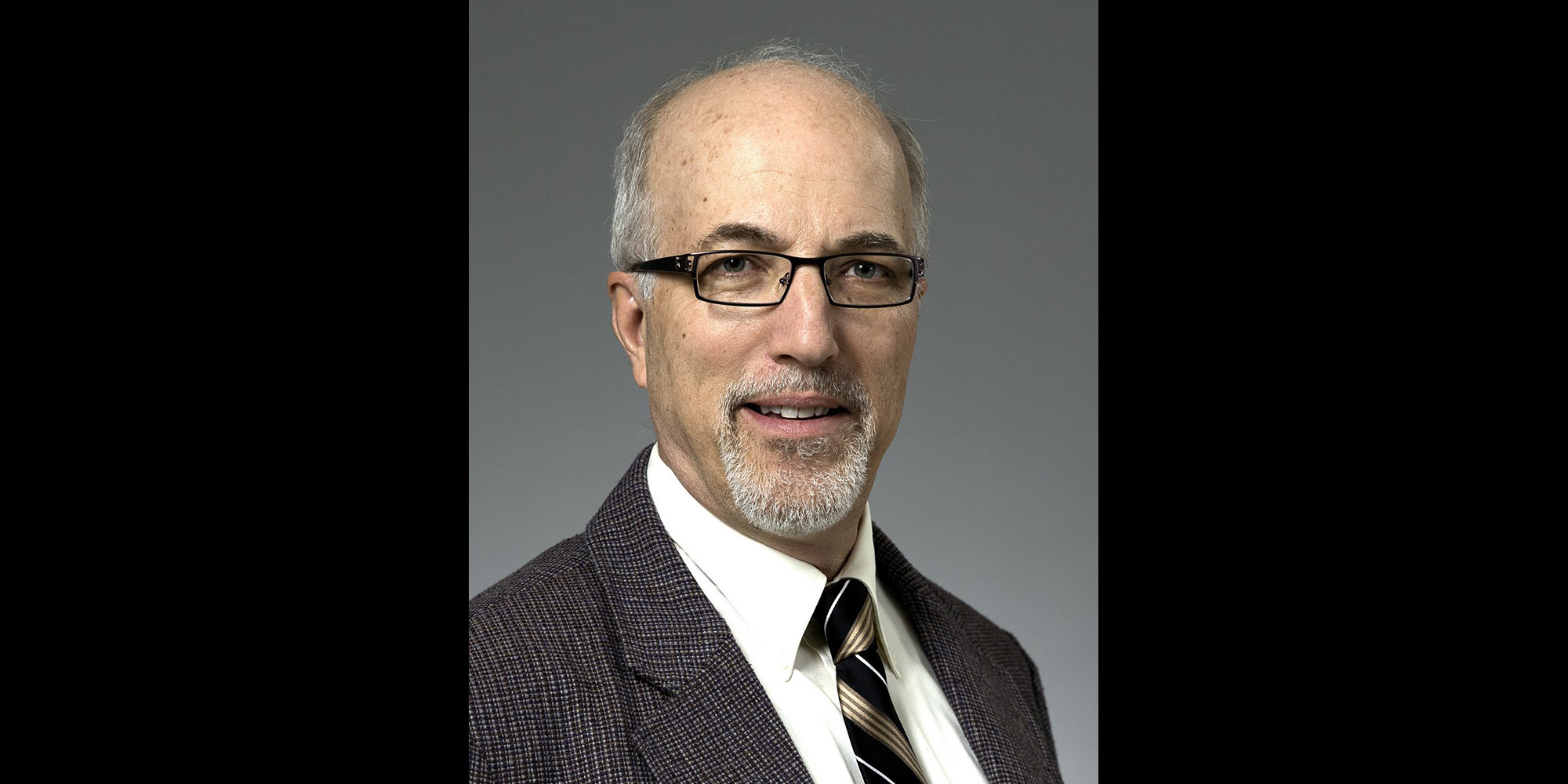
The commencement ceremony will be at 9 a.m., Sunday, May 5, in Yost Center. Mennonite World Conference President-elect, J. Nelson Kraybill, will present the commencement address.
Kraybill of Elkhart, Ind., serves as lead pastor of Prairie Street Mennonite Church (Elkhart) and will begin his six-year with MWC at the global assembly in Harrisburg, Pa., in July 2015. He is President Emeritus of Associated Mennonite Biblical Seminary (Elkhart) where he served from 1996 to 2008. He was also program director of the London Mennonite Center in London, England, from 1991 to 1996.
Student speakers for the ceremony are Mallory Eicher (Berne, Ind.) and Taylor Ermoian (Hays, Kan.).
Academic departments will recognize graduates in department specific ceremonies May 4.
Disaster Management students will be recognized at 9 a.m. in the Northlawn Studio Theatre. Paul Unruh (Hesston), a longtime Mennonite Disaster Service volunteer and member of the bi-national MDS Board of Directors will present the message “Ordinary People Doing Extraordinary Things.” As a member of the Disaster Management Program Advisory Committee, Unruh was influential in the formation of Hesston’s program in 2005. He frequently presents in disaster management classes about the importance of communicating with disaster survivors and introduces students to the world of MDS. Amy Repp (Valley Center, Kan.) will give a student reflection.
A pinning ceremony for nursing students will be at 10 a.m. in the Hesston Mennonite Church sanctuary followed by a reception in the church Community Center.
Pastoral Ministries commissioning will be at 1 p.m. at Hesston Mennonite Church followed by a reception in the church Education Hall. Kurt Horst, lead pastor at Whitestone Mennonite Church (Hesston) and a 1973 Hesston College graduate will present the message. Before returning to his hometown of Hesston, Horst served as administrator of Johnstown (Pa.) Christian School and as a pastor in Johnstown. He served as conference minister of Allegheny Mennonite Conference from 1996 to 2009.
Aviation and Air Traffic Control students will be recognized during a 2:30 p.m. reception in the Hesston Mennonite Church Community Center. Jonathan Rudy (Manheim, Pa.), father of 2013 Aviation graduate David Rudy and 2011 Aviation graduate and current Hesston flight instructor Solomon Rudy, will speak. Rudy is professor of Peace and Conflict Studies and scholar in residence at the Center for Global Understanding and Peacemaking at Elizabethtown (Pa.) College. Rudy and his family spent 15 years working for Mennonite Central Committee in Africa and Asia. He has also worked as an independent peacebuilding consultant in Afghanistan, the Phillippines, Burkina Faso, Kenya and South Sudan.
Other weekend events include a voice recital by sophomore Emerencia Dudas (Walbridge, Ohio) at 4 p.m., May 3 at Hesston Mennonite Church. Theatre students will present student-directed one-act plays at 7 p.m., May 3 and 3:30 p.m., May 4 in the Northlawn Studio Theatre. The Bel Canto Singers will present a concert at 4 p.m., May 4 at Hesston Mennonite Church as a precursor to their May tour to the east coast.
For a full weekend schedule or more information, visit the Hesston College website at hesston.edu or call the Alumni and Church Relations office at 620-327-8109 or toll free at 866-437-7866.
Hesston College to “go green” with Earth Day celebration
Biology
Physics
Hesston College will host an Earth Day celebration from 10 a.m. to 2 p.m. April 18 on the Hesston College campus. The come-and-go event is free and open to the public.
Coming just after the college’s week-long Sustainability Week followed by a week-long Wellness Week, the day’s theme will be “Lean, Clean and Thinking Green.” Activities will focus on conservation, recycling and solar energy and how to make those principles sustainable for the long term.
Classes and individuals from the science and math departments will present conservation methods for energy and water.
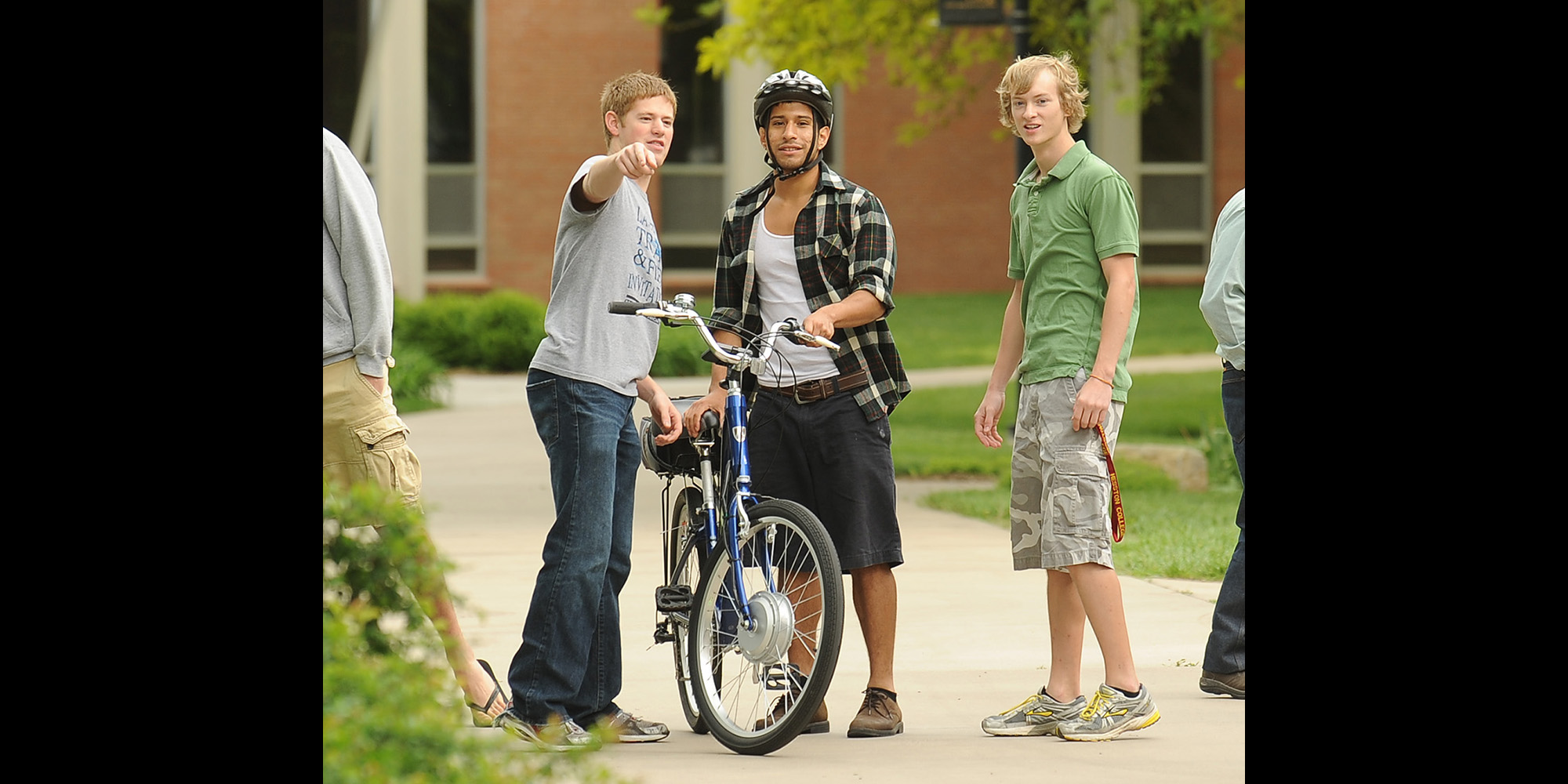
Physics students will offer presentations and rides on the electric bicycle and tricycle and will display a mode of a fuel cell car. They will also present a solar design for producing electricity for the campus science bulding. Nick King of King Solar in Hutchinson, Kan., will be on hand to answer questions and discuss solar photovoltaic installations. Environmental biology students will present information about their classroom material while microbiology students talk about water treatment. Members of the Hesston College Maintenance and Facilities staff will also talk about conservation efforts on campus.
Solar-cooked snacks will be offered from 11:30 a.m. to 1 p.m.
Bel Canto Singers to celebrate 30 years with east coast tour
Music
The Hesston College Bel Canto Singers will celebrate 30 years of making music with a May tour to the east coast May 6 to 16, highlighted by a four-day New York City excursion. While in New York, the choir will participate in a Carnegie Hall performance and perform solo concerts at Manhattan Mennonite Fellowship and the Cathedral of St. John the Divine. The group will make other performance stops in Illinois, Indiana, Ohio, New York, Pennsylvania and Virginia.
In 1983 Hesston College’s then choir conductor, David Rhodes, expanded the college’s tradition of outstanding vocal music with the formation of Bel Canto Singers – a mixed vocal ensemble that has become the college’s premiere choir.
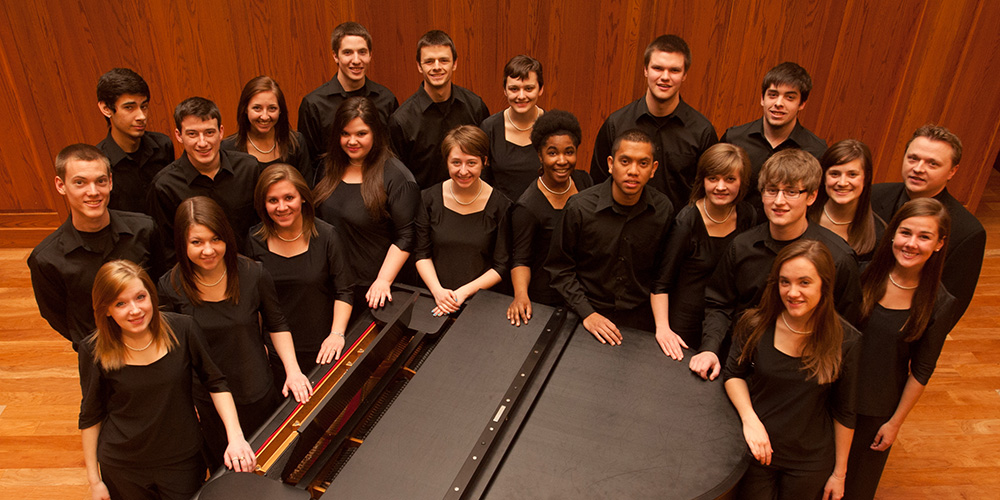
Bel Canto Singers typically has 20 to 22 members selected by competitive audition during the preceding academic year. Conducted by music faculty member Bradley Kauffman, the current roster includes 21 students from eight states and Indonesia. The choir will perform a program entitled “Songs of a Wayfarer,” a concert inspired by the campus-wide study of immigration during the 2012-13 year and the First Year Experience seminar common read “Enrique’s Journey” by Sonia Nazario.
Bel Canto Singers will join the Masterworks Festival Chorus presenting Johannes Brahms’ “Requiem” under the direction of Donald Neuen and with the New York City Chamber Orchestra at 2 p.m., Sunday, May 12, in Carnegie Hall’s Stern Auditorium. Advance tickets are required and can be purchased by calling Carnegie Charge at 212-247-7800 or visiting carnegiehall.org. Hesston College alumni and friends can receive a 15 percent discount by using the code MTN16606. Go to hesston.edu for more information.
Donald Neuen is a conductor of international renown, a composer, arranger, editor and educator. He conducts the University of California-Los Angeles Chorale and teaches conducting at UCLA’s highly-acclaimed graduate program. Neuen has also served as artistic director and conductor for the Angeles Chorale (Los Angeles), the director of the Cathedral Choir at the Crystal Cathedral (Garden Grove, Calif.), assistant conductor and director of choral activities for the Atlanta (Ga.) Symphony Orchestra and has served on the faculties at the University of Wisconsin (Madison), University of Tennessee (Knoxville), Ball State University (Muncie, Indiana) and Georgia State University (Atlanta).
“Singers develop a reverence for venues that offer a satisfying acoustical experience,” said Kauffman. “Carnegie Hall is one of the few places that combines a world-class acoustic with an overall aesthetic that is difficult to describe in words. When an opportunity to Sing the Brahms ‘Requiem’ coincided with our biennial May tour, I knew I wanted our students to have that experience.”
Bel Canto will also present a full solo concert hosted by Manhattan Mennonite Fellowship at 7 p.m., Friday, May 10 at the 15th Street Friends Meeting House, and a 30-minute solo concert at the 1892 Gothic revival church Cathedral of St. John the Divine in New York City at 2 p.m., Monday, May 13.
The full Bel Canto tour includes:
- 4 p.m., Saturday, May 4 at Hesston Mennonite Church
- 7:30 p.m., Monday May 6 at Arthur (Ill.) Mennonite Church
- 7:30 p.m., Tuesday, May 7 at Belmont Mennonite Church (Elkhart, Ind.)
- 7 p.m., Wednesday, May 8 at Kidron (Ohio) Mennonite Church. The Central Christian School (Kidron) Varsity Singers under director and Hesston alumnus Tim Shue will perform with Bel Canto. A reception will follow the concert with reflections on education in Mennonite Church USA from Central Christian superintendent Eugene Miller and Hesston College President Howard Keim.
- 7 p.m., Friday, May 10 at the 15th Street Friends Meeting House (New York City), hosted by Manhattan Mennonite Fellowship.
- 2 p.m., Sunday, May 12 at Carnegie Hall, Stern Auditorium. Advance tickets required.
- 2 p.m., Monday, May 13 at Cathedral of St. John the Divine, New York City
- 9:24 a.m., Wednesday, May 15 at Christopher Dock High School (Lansdale, Pa.)
- 7:30 p.m., Wednesday, May 15 at Blooming Glen (Pa.) Mennonite Church
- 9:54 a.m., Thursday, May 16 at Lancaster (Pa.) Mennonite High School
- 7:30 p.m., Thursday, May 16 at Park View Mennonite Church (Harrisonburg, Va.)
With the exception of the Carnegie Hall concert, all performances are free and open to the public, though a free-will offering will be collected to defer expenses.
Members of Bel Canto are Alex Bargerstock (Massillon, Ohio), Josh Booth (Newton, Kan.), Cory Bowman (Millersburg, Ind.), Neal Brubaker (Goessel, Kan.), Deni Brummer (Hutchinson, Kan.), Broxton Busenitz (North Newton, Kan.), Kaci Diener (Harrisonville, Mo.), Emerencia Dudas (Walbridge, Ohio), Rebecca Eichelberger (Geneva, Neb.), Bonita Garber (Bainbridge, Pa.), Kayla Kauffman (Hutchinson, Kan.), Janae King (Gordonville, Pa.), Morgan Martin (New Holland, Pa.), Levi Miller (Hesston, Kan.), Alisa Murray (Orrville, Ohio), Rebecca Rhodes (Arthur, Ill.), David Rudy (Manheim, Pa.), Jeffrey Smoker (Harrisonburg, Va.), Redfa Titihalawa (Papua, Indonesia) and Emily Taylor (Buhler, Kan.).

Program explores connections between racial and religious groups
General
Hesston (Kan.) College faculty members will present, “Common Threads: Anabaptist and African-American Songs and Stories of Suffering and Hope,” an original program that explores the way the historical events of Anabaptist religious persecution and African-American racial segregation intersected will be presented at 7 p.m., Saturday, April 20 at Madison (Wisc.) Mennonite Church, 1501 Gilbert Road. Hesston College will partner with Madison Mennonite Church to present the program, which is free and open to the public. A free will offering will be collected to cover program costs.
“Common Threads” is a program of story and song featuring Hesston College faculty members Tony Brown, John Sharp and Ken Rodgers. They give voices to Anabaptist martyrs and enslaved African-Americans of history by singing their hymns and telling their stories. It offers deeper understanding about the enslaved African-American and Anabaptist Martyr experience of suffering and hope. Youth are especially invited to attend.
“Both groups found strength and consolation in their steadfast faith in God,” Sharp said. “They were utterly confident that God’s purposes would, in the end, prevail. Their stories and songs have not typically been linked, but we believe it is useful to do so. Their witness stands for all who will see and hear.”
“Thinking about how we can connect with others and finding those common threads can offer promise for humanity,” Brown said. “In the end, we as a human species are more profoundly alike than different. It is the idea of difference that formed the basis for racism, persecution and systematic oppression. Humanity needs to find value in difference while at the same time exploring the common threads that bind us together.”
Brown is a professional baritone, artist in residence and sociology professor. Sharp is a history professor, storyteller and author. Rodgers is director of the Chorale and instructs in the music department. Alumni and Church Relations Director Dallas Stutzman will represent the college. A reception and short Hesston College update will follow the program.
The Hesston College group will also present “Songs and Stories of Peace, Hope and Justice” featuring Brown during the Sunday evening worship service at 6 p.m., April 21 at Madison Mennonite Church.
For more information, contact the Hesston College Alumni and Church Relations office toll-free at 866-437-7866.

General
A love for plants and an eye for the Kansas prairie’s beauty were the spark and vision for a treasured Hesston landmark that is left as Evie Dyck’s ongoing legacy with the Dyck Arboretum of the Plains. Evie passed away April 7, at the age of 88.
The Dyck Arboretum was a wheat field on the edge of town when Evie and her husband, Harold, who passed away in 2007, donated its 31 acres to Hesston College in 1981. After being inspired by a trip to the Bartlett Arboretum near Belle Plaine, Kan., the Dycks wanted to create a place in Hesston where people of all ages could enjoy nature, find a peaceful place for reflection and encourage a greater understanding and appreciation of the prairie.
“They started the arboretum because of my mother’s great love of the Kansas prairie and the Great Plains and her spiritual connection to nature and God’s creation,” said Julia (Dyck) Roupp, one of Harold and Evie’s daughters, in a 2007 interview following Harold’s death.
Their vision has been recognized many times over for the thousands of people who visit the arboretum each year for educational events, entertainment or simple enjoyment of nature. Its location next to Schowalter Villa and a block south of the college makes it a convenient place to unify people across the age spectrum.
“Few communities the size of Hesston have a public garden,” said arboretum director Scott Vogt. “Evie had a love and appreciation for the Kansas landscape. The Dyck Arboretum is a tremendous gift to the community and has become a regional attraction. Her legacy is established in the arboretum and will linger as it continues to flourish.”
With many family and personal ties to Hesston College, as Evie and Harold planned to make an arboretum in the community a reality as a non-profit educational facility, gifting it to the college and operating with its business and logistical supervision made sense. “This broadened the scope from enjoyment to education and physical fitness,” Evie said in 1999.
“Evie and Harold’s gift of the arboretum to Hesston College has contributed to student learning in many ways, as well as being an educational and rejuvenating gift to the community,” said Hesston College President Howard Keim. “It has exceeded their dreams of 30 years ago and will always pay tribute to their legacy and the kindness and generosity with which they gave.”
On October 11, 1981, the first of what would become many trees at the arboretum was planted. Since then, the arboretum has matured into one of the largest native plant gardens in the region, featuring more than 1,000 varieties of native and adaptable vegetation. It has also expanded from 13 acres at its inception to include the remaining 18 acres and added a visitors’ center in 1999, a pavilion for events in 2011 and other features to assist in operations and aesthetics.
Evie’s connections and contributions to the college were many. She was a 1952 graduate of Hesston Academy – the private high school that was part of the college for many years – her son, Gary, was a graduate of both Hesston Academy and Hesston College, and two of eleven grandchildren, Kate (Dyck) Brownstone and Connor Dyck, are also Hesston College graduates. The daughter of Elmer (E.D.) and Amy (Erb) Hershberger, her grandfather, T.M. Erb, was Hesston College’s first business manager and several other relatives were longtime Hesston instructors. Evie served on the college board, and she and Harold enjoyed hosting students in their home. They were also members of Hesston Mennonite Church on the edge of the college campus.
In 1985, the Dycks established an endowment fund to help with the upkeep and growth of the arboretum so it can continue to be a gift to the community for years to come. The endowment is supported annually by about 600 patrons through membership.
“Evie’s wishes and vision live on in the plants, landscapes, buildings and educational programs,” said Vogt. “This garden gives visitors a sense of place. We hope visitors will leave this garden with a renewed appreciation of the cultural and natural history of the Great Plains.”
Evie was preceded in death by her husband Harold and is survived by four children and their spouses – Gary and Teresa Dyck (Frankston, Texas), Joycelyn Cooley (Newton, Kan.), Tom and Regina Dyck (Hesston) and Julia and Brad Roupp (Ashland, Ore.) – and 11 grandchildren.
She is also survived by thousands who, through the Dyck Arboretum of the Plains, have realized her vision, discovered the beauty of Kansas and love her garden.

Hesston College to host church leader in residence
Bible and Ministry
General
Longtime Mennonite Mission Network employee and recent retiree John Powell of Elkhart, Ind., will serve as Hesston College church leader in residence April 7 to 10. He will share about his experiences working for inclusion and overcoming racial oppression in the Mennonite church and broader social systems during Hesston College chapel services at 11 a.m., Monday, April 8, and Wednesday, April 10, at Hesston Mennonite Church. The public is invited to attend.
Powell grew up in Alabama experiencing injustices because of his African-American race and heritage. He learned early in life that that kind of treatment was not okay when he saw his father stand up to the Ku Klux Klan.
In high school he met Martin Luther King Jr. who mentored him over the next four years to become a conscientious objector. In looking at peace churches, he was drawn to the Mennonite church because of voluntary service workers with whom he encountered and worked.
Powell served in various capacities in the Mennonite church including pastor of 10th Street Mennonite Church in Wichita, Kan., in 1968. He then served as executive secretary for the Minority Ministries Council in Elkhart for five years, where he worked on ways to empower African-American, Hispanic and Native American congregations within the Mennonite church. In 1974 he left the denomination because of anger he felt toward the racist structures within the church.
Over the years, he began reconciling with the Mennonite church and in 1995 began working as church development consultant with Mennonite Board of Missions, which later became Mennonite Mission Network. He served in various other roles within the Mission Network before he retirement in January 2013.
Powell has experience not only in working against social injustices, but also in teaching, social work, community organization, education and state government administration, organizing labor unions, pastoring, research in urban and regional planning, evangelism and mission advocacy.
Area pastors are invited to attend a complimentary lunch and seminar with Powell at 11:45 a.m., Wednesday, April 10. Powell will speak on “Being an Ally in a Multi-Ethnic/Cultural World.” Pastors interested in attending Wednesday’s activities can contact the Hesston College Church Relations Office at 620-327-8109 or toll free at 866-437-7866.
Intergenerational connections to host concert
Music
A group of college men – the Hesston College Amen Group – and the Hesston Area Senior Center will partner to host an evening of intergenerational connections and music by local group The Jammin’ Biscuits at 7 p.m., Saturday, April 20, at the Hesston Area Senior Center. The concert is open to the public. Admission is a donation to the Hesston Community Free Health Fair.
The Jammin’ Biscuits perform bluegrass, gospel and traditional music with distinctive four-part harmony.
The Hesston College Amen Group seeks to develop the character and personal growth of young men.
Doors will open for the concert at 6:30 p.m. for any interested people to participate in a jam session. Musicians must bring their own instruments. People of all ages are welcome.
Members of the Jammin’ Biscuits are Gerry Roberts, Tracey Roberts, Gary Roberts, Tom Unruh, Rollin Schmidt and Nick Johnson.
Music students prepare lineup for recitals
Music
The Hesston College Music Department will feature several students in sophomore recitals as the academic year approaches its close.
Ashley Beatty and Alisa Murray will perform a joint violin and voice recital at 4 p.m., Saturday, April 13, in the Northlawn Studio Theatre on the Hesston College campus. Vocalist Broxton Busenitz will perform his recital at 7 p.m., Tuesday, April 16 at Hesston Mennonite Church on the Hesston College campus. The public is invited to attend.
Beatty, a violinist from Washington, Iowa, studies under adjunct instructor Rebecca Scholoneger. She is the daughter of Mark and Susan Beatty.
Murray, a soprano voice student from Orrville, Ohio, studies under adjunct instructor Holly Swartzendruber. She is the daughter of Randy and Amy Murray.
Beatty and Murray will be accompanied by collaborative pianist and Hesston College music faculty member Ken Rodgers. Selections will include pieces by several classical composers from across the centuries and vocal pieces in their traditional languages.
There will be a reception following the recital in the Northlawn lobby.
Busenitz, a tenor voice student from North Newton, Kan., studies under music faculty member Matthew Schloneger. He is the son of David and Gayle Busenitz.
Busenitz will also be accompanied by Rodgers and selections will include classical and contemporary sacred works as well as a set with the gospel ensemble Hearts 4 Him, of which Busenitz is a member.
Following the recital, there will be a reception in the Hesston Mennonite Church Community Center.

Award-winning German a cappella group to close out HBPA season
Music
The refined vocal excellence of Calmus, a German a cappella ensemble, will round out the 2012-13 Hesston-Bethel Performing Arts season with a concert entitled “Bright Side of Life” at 3 p.m., Sunday, April 14, at Hesston Mennonite Church on the Hesston College campus. Following the concert, HBPA will host a dessert reception in the Hesston Mennonite Church Community Center. Season ticket holders have free admission to the dessert reception and non-season ticket holders can purchase their admission for four dollars at the door.
Calmus presents a unique quintet combination of a pure female soprano voice with four male voices ranging from bass to countertenor, each a graduate of the renowned St. Thomas Church Choir Singing School in Leipzig, Germany. Together they have mastered the art of close harmonies to create a perfect blend of sound and precision, and have earned the honor of one of the most successful vocal groups in Germany. Their repertoire comes from a limitless range of music, from Renaissance and Baroque masters to contemporary choral and popular songs.
“We are excited to cap off our season with one of the world’s most up-and-coming vocal ensembles,” said HBPA director Matthew Schloneger. “Patrons who enjoy a cappella music in the style of The King’s Singers or Chanticleer will fall in love with Calmus.”
The “Bright Side of Life” program is named after Eric Idle’s popular sing-a-long comedy song “Always Look on the Bright Side of Life,” first featured in the 1979 film “Monty Python’s The Life of Brian.” It features classical works by Heinrich Schultz, Henry Purcell, Robert Schumann, Benjamin Britten and Adriano Banchieri as well as popular a cappella works by Elton John, Leonard Cohen and Bobby McFerrin.
Calmus began as a men’s ensemble in 1999 shaped by the centuries-old tradition of boys’ choirs and rich choral traditions of its hometown of Leipzig’s musical heroes, Bach and Mendelsshon. As the group was forming, they chose to forgo the more recognized quartet arrangement and, inspired by the British “King’s Singers,” added a fifth member in order to sing more complex arrangements. Over time, the group’s membership changed, including adding a female voice in 2001.
The group receives rave reviews from musical critics around the world. Salt Lake City’s “Deseret Morning News” described a local concert as “nothing short of remarkable…they, quite simply, bring whatever they sing to glorious life.”
In 2009 Calmus was the first-prize winner of the Concert Artists Guild International Competition, and have won many other international prizes and competitions, including the 2009 ECHO Klassik Award for “Leid: Gut!” an album of treasured German folksongs and first prizes at the fourth annual Robert Schumann Choral Competition, the International Competition for Vocal Ensembles and the 37th Tolosa Choral Contest in Spain. They regularly travel across Europe and North and South America partnering for performances with instrumental groups and commissioning numerous new works from composers.
Single tickets for the Calmus concert are available for $17 or $20 with discounts available for students and senior citizens.
For more information or to purchase tickets, call 620-327-8158 (Hesston College) or 316-284-5205 (Bethel College) or visit the HBPA website at hesstonbethel.org.
HBPA is funded in part by Excel Industries and Hustler Turf Equipment (Hesston), the cities of Hesston and North Newton and area patrons.