
In the News
December 10, 2025
Fowl predicament at Hesston College uncovers irreplaceable flock
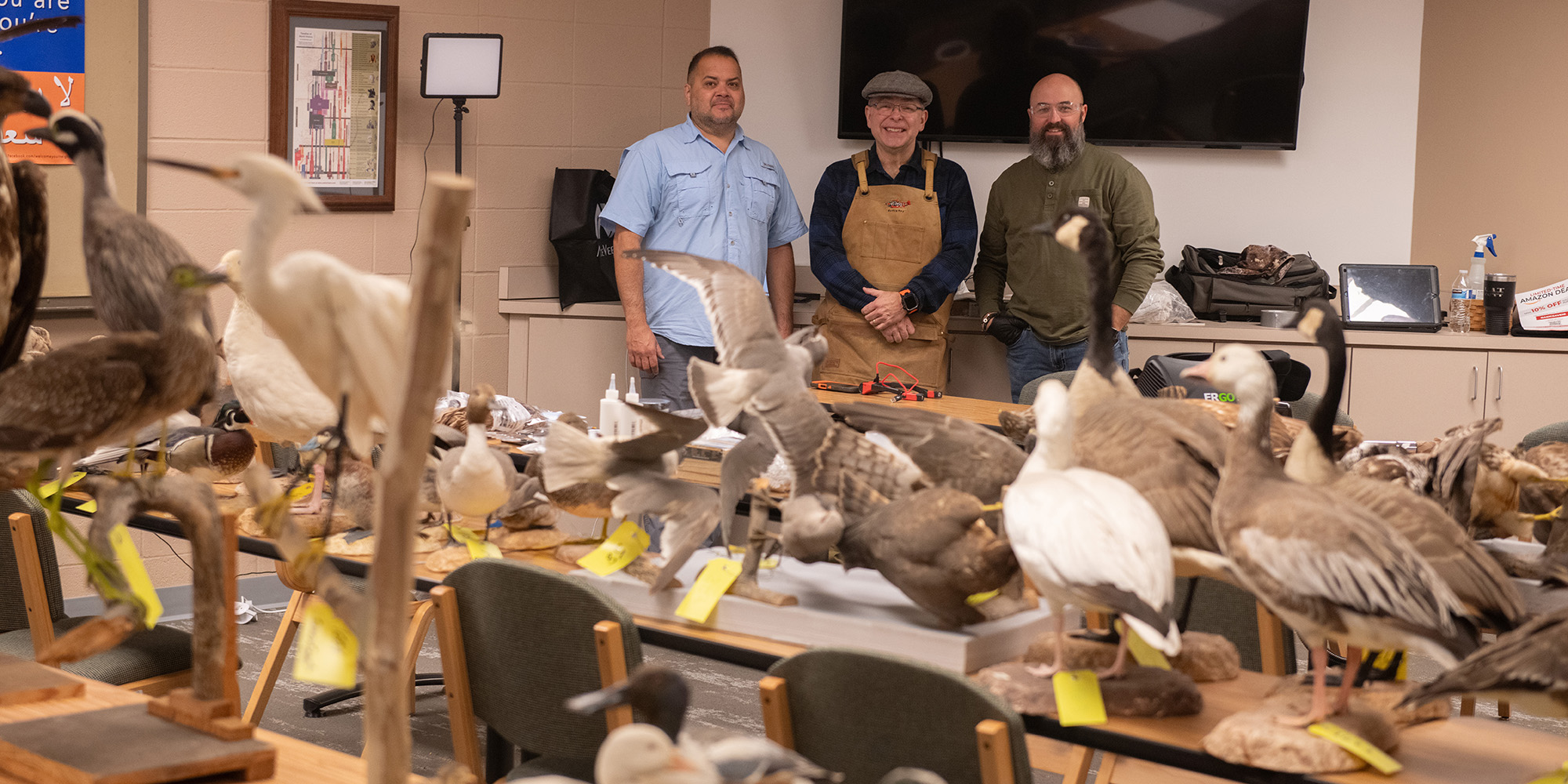
The smoke has cleared in Hesston College’s J.D. Charles Hall of Science and Arts, but cleanup is still underway following a May 9 fire that left the building unusable for the current academic year. While restoration efforts have been in full force over the past several months, the fate of HC’s feathered friends in the building was uncertain.
The specimens in question were part of an exhibit prepared from 1948 to 1956 by Richard Schmidt, then-HC staff taxidermist from Goessel, Kan., for Hesston College’s Maurice Yoder Memorial Museum located in Charles Hall. The collection was not exposed to the fire, but chemical smoke damage coupled with arsenic used in their preservation 70 years ago resulted in 260 specimens with an unknown future.
After several failed attempts to connect with a taxidermist willing to take on the extensive project of cleaning and restoring over 200 birds, Hesston College was at a loss. Numerous inquiries from community members as to the fate of this collection made the value to the HC community apparent, but without someone willing to do the necessary work to restore them, the college was running out of options to keep the birds.
Moving forward on a wing and a prayer, Ben Miller, Hesston College director of campus facilities, was able to connect with Wes Becker, president of the Kansas Association of Taxidermy (KAT) and the owner of M&W Taxidermy in Mount Hope, Kan. Once Becker learned that renowned taxidermist Richard Schmidt was the creator of this collection, it was enough to pique his interest and make the short road trip to Hesston to see the collection for himself.
“I was pretty amazed with the variety of birds,” Becker recalled. “Richard obviously specialized in those little tiny birds, but the quality of the work, even still today, is as good as 90% out there. It’s top quality work for sure.”
After the visit, Becker secured additional support from another industry expert, Museum Conservation and Wildlife Art Specialist Rick Krane of New Hampshire, who is also president of Anglers Artistry Inc. The duo were able to work with HC to quickly get the ball rolling and are currently on location, working to restore every bird in the collection.
This was a surprise, but a welcome turn in events for Hesston College as the true value of this collection has been uncovered. In fact, Krane shared in initial conversations with the college that this collection is literally “irreplaceable.”
“Older, cohesive avian collections that haven’t been broken up, damaged or lost to time are disappearing,” he said. “Maybe a couple dozen remain in any real continuity, and even that number shrinks each decade.”
Becker also spoke to the value of this collection saying, “Just the variety of birds, to be able to get to see birds that you can’t legally harvest, you can’t legally possess or anything. I think almost every single bird in there is federally protected. Even zoos don’t have most of these.”
Sharing in their sentiments is emeritus HC faculty member Lorna Harder.
“We have here a collection of birds, many of which are becoming rare,” she said. “They’re not necessarily threatened or endangered status, but they’re on watch lists already because the numbers have just been declining.”
It’s safe to say Schmidt is a legend in the taxidermy world, adding additional value to the collection. KAT even established the Richard H. Schmidt Memorial Award of Excellence in his honor. Each year it’s given to the highest scoring mount at their annual state competition. KAT’s website says, “This award is meant to honor all the hard work, passion, high standards and mastered abilities that went into a taxidermy piece to make it as close to real life as possible. It is the most elite and sought after award for the KAT and its members.”
“Preparators like Schmidt built the foundation for how America learned its wildlife,” Krane explained. “You can see that heritage in the Hesston pieces: the wiring, the posture, the feather articulation…it all speaks to a period of meticulous, disciplined workmanship. These mounts weren’t made for décor; they were made for education, for accuracy, for truth.”
Krane says the significance of this bird collection is three-fold. There’s historical significance as it provides a snapshot of a quickly fading academic era. Scientifically, it preserves forms and morphology. There’s also artistic significance as it represents a now very rare school of craftsmanship.
“This isn’t just a group of birds,” he shared. “It’s an intact chapter of natural history, and sadly there are very few chapters like this left.”
Over the years, the collection has remained a constant in its original exhibit space in Charles Hall, giving Hesston College biology and science students an up close and personal view of the winged creatures, adding a level of educational significance. Harder also recalls it being a resource for area schools to visit, as well as adult groups, when she worked in Charles Hall in the 1980s.
“But beyond that, it is a resource that very few colleges have,” she explained. “And our college is small, our community is small, and it’s accessible to a large number of people on a regular basis who want to come and look and see. I think accessibility is huge.”
Schmidt’s family was also grateful to learn about the turn in events.
"The descendants of Richard H. Schmidt are very pleased that Hesston College will be able to restore his taxidermy mounts after the fire. He made these more than 70 years ago, so it's wonderful to know they will be in good shape for years to come,” shared Paul Schrag of Newton, Kan., Schmidt’s grandson. “As supporters of Mennonite higher education, maintaining a high-quality display at Hesston College is important to us, and we trust that current and future students will benefit from the products of his skill and dedication."
Krane and Becker are on campus now, working under Krane’s Academy of Wildlife Art, to clean and restore all of the birds in the collection. They expect to complete the project in about a week. At that time, the collection will be stored safely while the cleaning and restoration of Charles Hall continues. The collection won’t remain caged up for long, though.
“The college is committed to getting the collection back on display,” Hesston College President Mark Landes said. “We also hope to create an enhanced exhibit space that students and the community can enjoy for generations to come.”