
Photo release: Larks take flight
Aviation
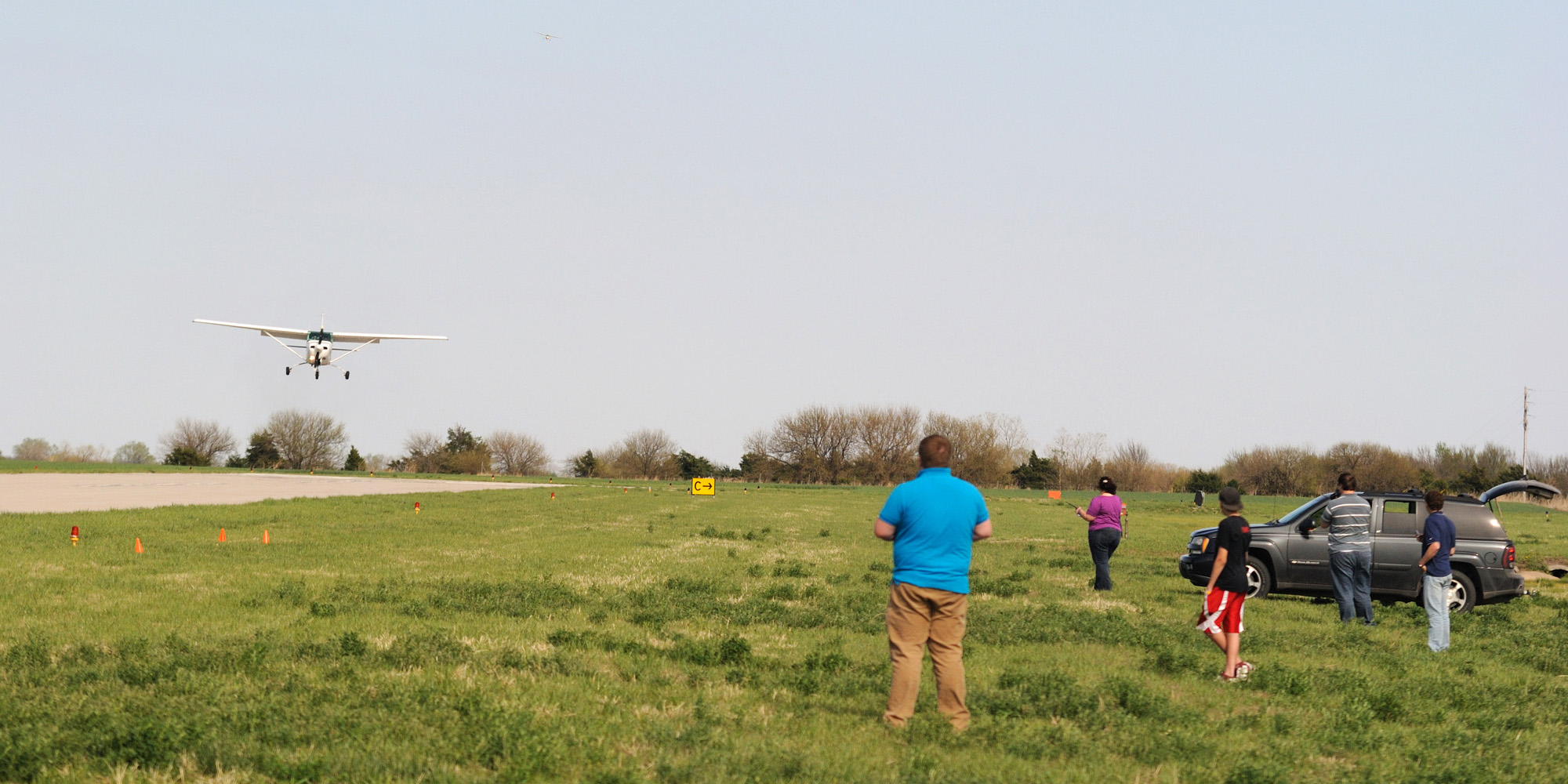
Hesston College flight instructors and onlookers watch approaching planes during the Aviation department’s annual Larks Flight Rally April 16 at the Newton City/County Airport. Aviation students and alumni competed in a flour bag drop competition and a landing competition. The day started with a presentation by Loren Groff, a 1991 Hesston College graduate and former Hesston flight instructor who is employed as a Transportation Safety Research Specialist at the National Transportation Safety Board in Washington D.C. Photo by Curtis Denlinger.

Hesston College to present “Common Threads” in Colorado Springs and Denver
General
Hesston College will host “Common Threads: Anabaptist and African-American Songs and Stories of Suffering and Hope” at 6:30 p.m. Saturday, April 30, at Beth-El Mennonite Church in Colorado Springs and at 9:30 a.m. Sunday, May 1, at First Mennonite Church in Denver. The events are free and open to the public, though a free-will offering will be received to cover program costs at the Colorado Springs performance.
“Common Threads” is a program that features Hesston College faculty members Tony Brown and John Sharp. Brown is a professional baritone, artist in residence and sociology professor. Sharp is a history professor, storyteller and author. They will give voice to Anabaptist martyrs and enslaved African Americans by singing their hymns and telling their stories. It is an exploration of the way Anabaptist religious persecution and African-American racial suffering have intersected. Both groups have suffered at the hands of legitimate governments, and both found hope in the midst of pain and humiliation.
“Both groups found strength and consolation in their steadfast faith in God,” Sharp said. “They were utterly confident that God’s purposes would, in the end, prevail. Their stories and songs have not typically been linked, but we believe it is useful to do so. Their witness stands for all who will see and hear.”
“Thinking about how we can connect with others and finding those common threads can offer promise for humanity,” Brown said. “In the end, we as a human species are more profoundly alike than different. It is the idea of difference that formed the basis for racism, persecution and systematic oppression. Humanity needs to find value in difference while at the same time exploring the common threads that bind us together.”
Following the Colorado Springs program, all attendees are invited to a reception. Alumni and friends of Hesston College are especially invited to attend.
Beth-El Mennonite Church is located at 4625 Ranch Drive in Colorado Springs. First Mennonite Church is located at 430 West 9th Avenue in Denver.
For more information, contact Dallas Stutzman, Hesston College Alumni and Church Relations director at 866-437-7866.
Located 30 miles north of Wichita, Hesston College is the two-year liberal arts college of Mennonite Church USA.
College and preschool students learn from each other
General
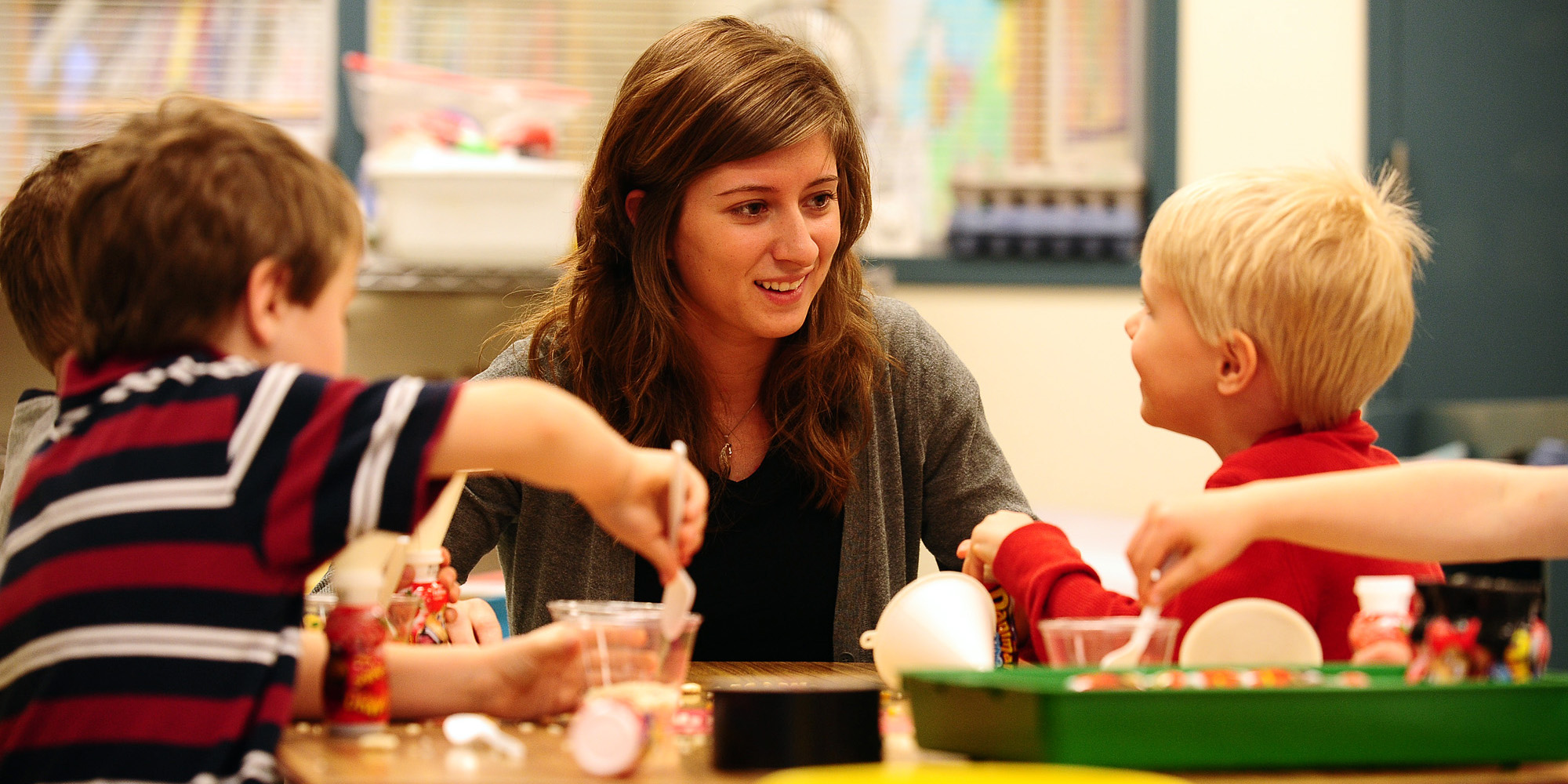
There is rarely a lack of energy in the Hesston College Lab Preschool and a recent week learning about the importance of recycling was no exception. The preschoolers spent the week creating their own books, sorting recyclable items into the correct bins and creating 3-D art by gluing together recyclable materials.
The only difference was the lead teacher for the week was actually a student.
“I love working with the kids and applying what I learn in my classes to the preschool classroom,” said Hesston College sophomore Deb Yoder.
Yoder, of Apple Creek, Ohio, recently coordinated the entire week of preschool as part of her semester of field experience as an Early Childhood Education major. The week was structured to teach the reduce, reuse, recycle concept, and Yoder organized stories, songs, art projects and other activities for active learning.
A year of voluntary service with Mennonite Mission Network’s Service Adventure program between her senior year of high school and starting at Hesston helped Yoder discover her passion for teaching young children as she worked with at-risk children in a non-profit preschool in Raleigh, N.C.
Her experiences at Hesston have been a step toward aspirations of working with children and families.
“Being able to work directly with children through Hesston’s program has given me a lot of knowledge to back up how I interact with them, and made me more intentional in those interactions,” said Yoder.
For almost 40 years, the lab preschool has been an integral part of the Early Childhood Education curriculum. College students and pre-kindergarten children learn together and from each other.
Hesston College faculty member Tami Keim serves as director of the Early Childhood Education program, a role she has held since 1987. Keim’s main focus is guiding the students’ learning in the college classroom, teaching child development and educational principles and philosophies for working with young children.
Larisa Lawrence, a 1993 graduate of the program, is a Hesston College faculty member and serves as lead teacher in the preschool. Lawrence’s main focus is teaching the children, but as college students are incorporated into the teaching process and day-to-day operations of the preschool, she educates them as well.
As Yoder has progressed through the program over the last two years, her responsibilities in the preschool have increased. Students begin the program with observation – taking note of Lawrence’s interactions with the children, behaviors and how children respond to different teaching methods. They move on to planning one small or large group activity each week, help process weekly lesson plans and finally, as sophomores, function as an integral part of the planning and teaching team during their field experience.
The program reaches across a variety of college majors as well. Some students use their two-year degree to join the professionals working in child care programs or private preschools. Others transfer into teacher education or social science programs at four-year institutions. Hesston’s program gives students a chance to explore their interest in working with children.
“The preschool is a unique element of Hesston’s program,” said Keim. “Students are able to develop their personal education philosophies as they work with the children. They also gain practical experience, which helps them learn more effectively. The preschool allows the students to make a direct connection between learning in class and preschool experiences.”
Aside from the benefits for the college students, the preschool is a mutually beneficial arrangement with the community, giving local families an option for private education. Just like the Hesston College students, children in the preschool benefit by receiving personal attention from their teachers.
“The preschool promotes a strong social, emotional and educational opportunity for our kids,” said Megan White of Hesston, whose son, Will, is enrolled at the preschool. “The passion and involvement of Hesston College students studying Early Childhood Education brings a valuable dynamic to both generations.”
Someday Yoder hopes to own and operate her own preschool, but until then she plans to continue using her Hesston experience working in preschool or child care settings.
“The guidance and constructive criticism I have received from Tami and Larisa has been invaluable,” she said. “I love seeing the obvious connections kids make in their learning. Seeing them figure something out for themselves is very rewarding.”
For families interested in enrolling their children in the Hesston College Lab Preschool for the 2011-12 year beginning in September, or for more information, contact Larisa Lawrence at 620-327-8161.
by Rachel Schlegel
College to celebrate 2011 graduates May 8
General
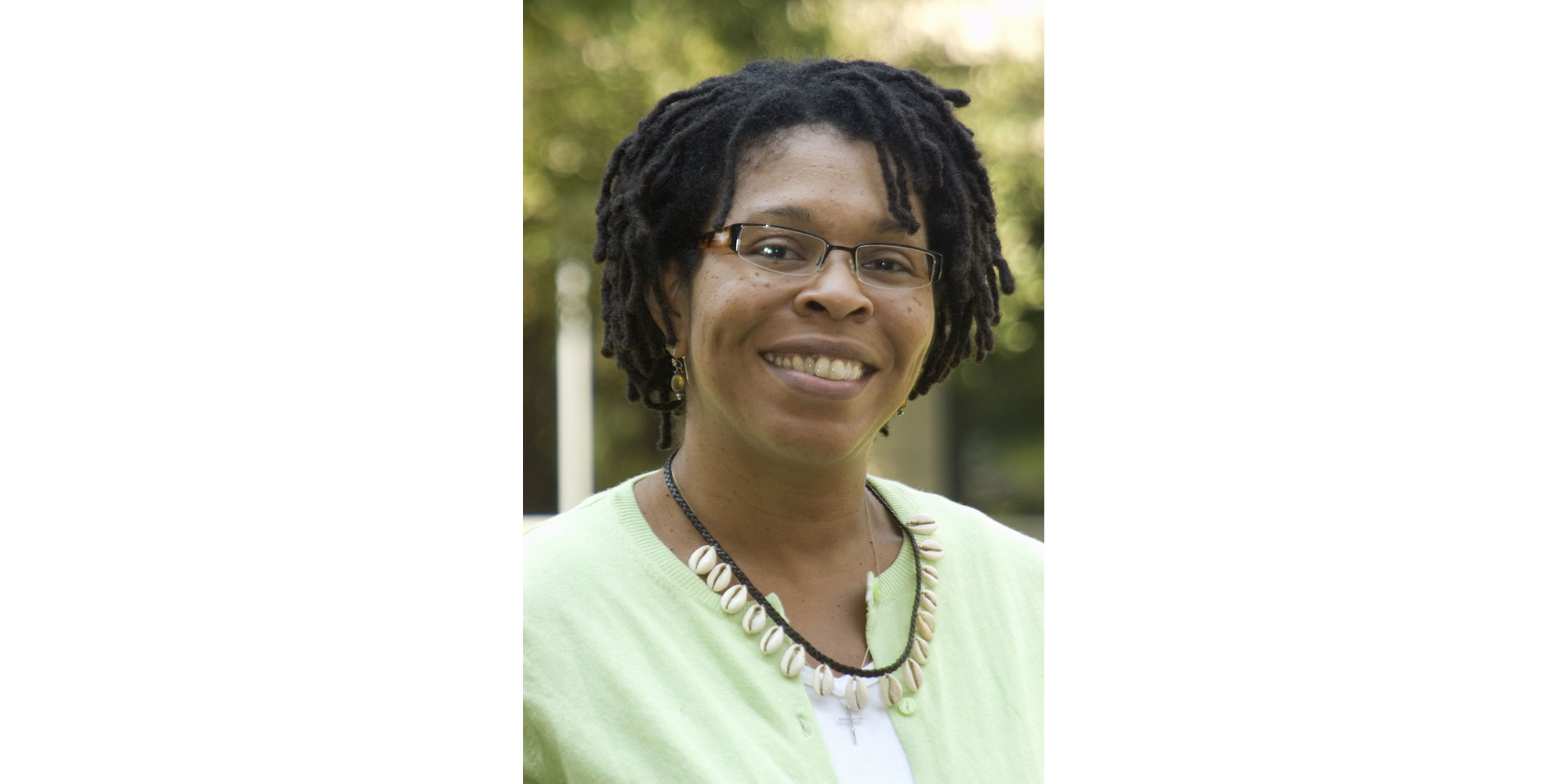
Hesston College will celebrate the class of 2011 with the 101st commencement ceremony at 9 a.m. Sunday, May 8 in Yost Center. Regina Shands Stoltzfus, a professor at Goshen (Ind.) College, will address the college’s 139 graduate candidates.
Stoltzfus has taught in the Peacemaking, Justice and Conflict studies and the Bible, Religion and Philosophy departments at Goshen since 2004. She is also an adjunct professor at Associated Mennonite Biblical Seminary in Elkhart, Ind.
Prior to her teaching positions, she served as an associate pastor at Lee Heights Community Church in Cleveland, Ohio, as campus pastor at Goshen College, as Minister of Urban Ministries with Mennonite Mission Network in Elkhart and as staff associate for urban peacemaking with Mennonite Conciliation Service in Akron, Pa. She is a co-founder of Damascus Road, an anti-racism education program.
Stoltzfus is a doctoral student in theology, ethics and contemporary culture at Chicago (Ill.) Theologcial Seminary. She also has a B.A. in English from Cleveland (Ohio) State University and an M.A. in biblical studies from Ashland (Ohio) Theological Seminary.
Stoltzfus’ daughter, Rachel Stoltzfus, is a graduate in the 2011 class.
Student speakers for the ceremony are Leah Rittenhouse of Mount Pleasant, Pa., and Alex Roth of Hesston, Kan.
The class of 2011 will be recognized for its accomplishments during Larkfest at 7:30 p.m. Saturday, May 7 in the Hesston Mennonite Church sanctuary. A reception will follow in the Community Center.
Individual student groups will be recognized in ceremonies Saturday, May 7. Disaster Management students will be recognized at 9 a.m. in Kropf Center, room 150. A pinning ceremony for nursing students will be at 10 a.m. in the Hesston Mennonite Church sanctuary. Steve Kelly, President and CEO of Newton Medical Center, will be the featured speaker. Pastoral Ministries commissioning, with Hesston College President Howard Keim as the featured speaker, will be at 1 p.m. in the church sanctuary. Aviation and Air Traffic Control students will be recognized during a 2:30 p.m. reception in the Bontrager Student Center.
Other weekend events include a sophomore recital at 4 p.m. Friday, May 6 in the Hesston Mennonite Church sanctuary. The recital will feature Andy Miller of Marion, S.D., and Perry Andre of Wauseon, Ohio. A tree dedication in memory of Chloe Weaver, class of 2010, will be at 3 p.m. May 7. Bel Canto Singers, under the direction of Bradley Kauffman, will perform a bon voyage concert as a precursor to their extensive west coast tour at 4 p.m. May 7 in the Hesston Mennonite Church sanctuary.
Performances of student-directed one-act plays, “Potholes” and “He’s Having a Baby” will be at 7 p.m. May 6 and 1 p.m. May 7 in the Northlawn Studio Theatre. Tickets are $3 for adults and students. Children ages 6 and younger are free. Tickets may be purchased in advance at the Hesston College Bookstore in person, by calling 620-327-8105 locally or toll-free at 866-437-7866, ext. 8105 or online at www.hesstonbooks.com. Tickets are subject to availability and may also be purchased at the door 30 minutes prior to show time.
For a full weekend schedule or more information, visit the Hesston College website at www.hesston.edu or call Alumni and Church Relations locally at 620-327-8109 or toll-free at 866-437-7866.
Hesston College students compete in peace speech contest
Bible and Ministry
Ron Moyo, North Newton, Kan., a freshman in the Hesston College Pastoral Ministries program won first place in the college’s annual C. Henry Smith Peace Oratorical Contest on April 12. Moyo was one of three Hesston College students who spoke on a variety of peace and justice issues during the competition.
In his speech, “Peace,” Moyo talked about the misconceptions and stereotypes that we have of various countries.
“All these misconceptions have been influenced by violence,” said Moyo. “We need to be intentional about creating peace. Peace is not about jumping into a plane and signing a peace treaty that is only enforced on paper.”
Moyo said he believes peace begins with the individual, and he sees the qualities of a peace maker in Hesston faculty member Dave Osborne.
“Dave is an educator by calling, but is also a peacemaker. He has devoted his life to bringing about peace,” commented Moyo.
Moyo received $125 and the opportunity to compete in an intercollegiate competition with contest winners from other Mennonite-affiliated colleges and universities. The runner up was Robert Howell, a freshman from Newton, Kan., who received $100 for his speech. Elyse Terry from Bluffton, Ohio, took third place.
The speeches were judged on their adherence to a social justice theme, use of supporting evidence and organization. Elements of presentation such as vocal variety, eye contact and spiritedness were also considered in the judging criteria.
The trust of C. Henry Smith, a Mennonite historian and professor at Goshen (Ind.) College and Bluffton (Ohio) University, funds the contest, which gives students an opportunity to become involved with the peace cause while cultivating rhetorical skills.
“Not many of us have taken time to care, but if a few of us could be like Dave, the world would be filled with bridges of love and understanding,” said Moyo.
Hesston College sophomores to perform recital
Music
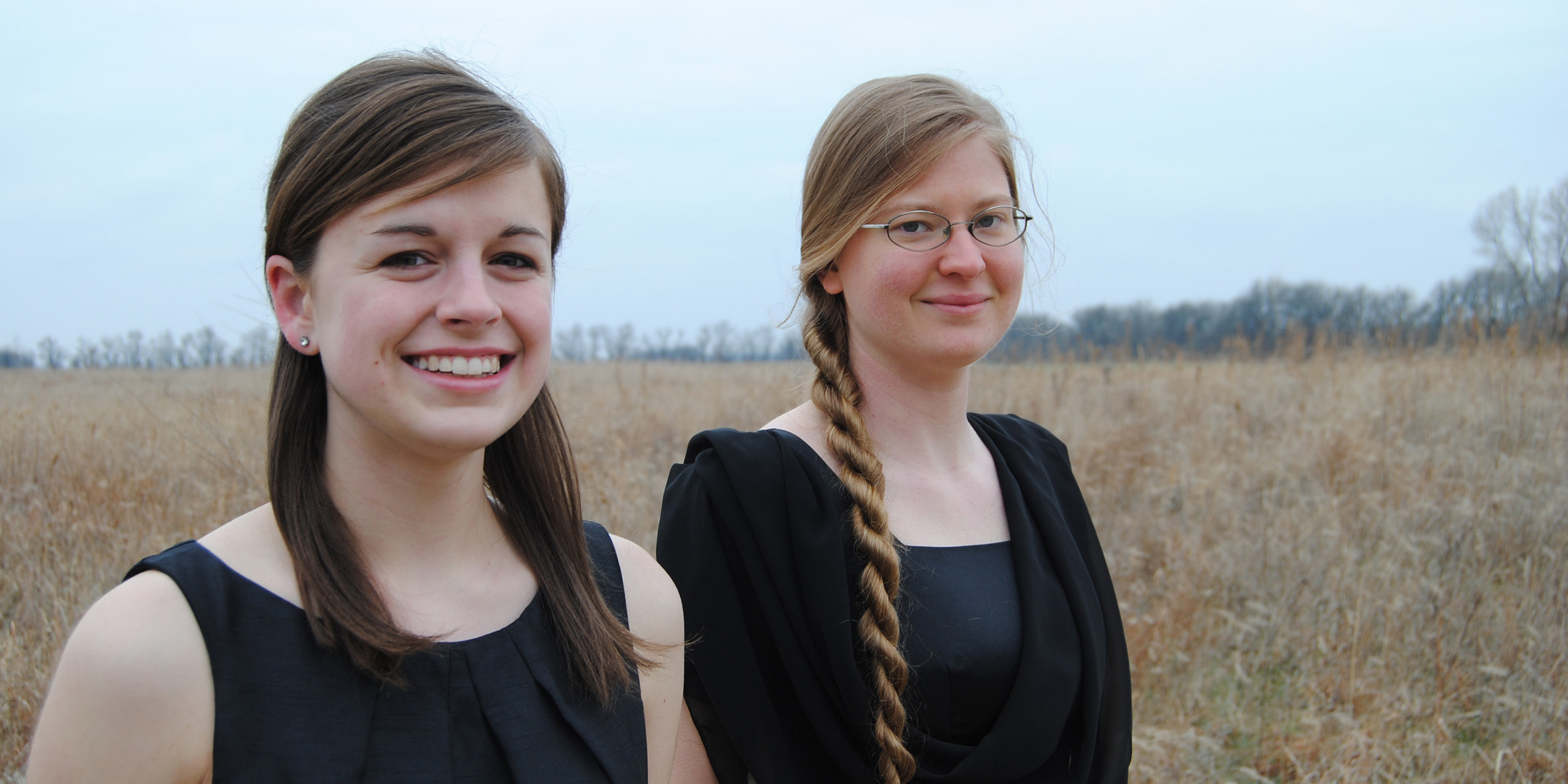
Hesston College music students Amy Brubaker and Sheralynn Neff will join together for their sophomore recital at 7 p.m. April 15 in the Hesston Mennonite Church sanctuary. The public is invited to attend.
Brubaker, a clarinetist of Goessel, has been a member of the Concert Band and Bel Canto Singers, both under the direction of Bradley Kauffman, for two years, as well as a clarinet student of Jim Pisano. She is the daughter of Karl and Marcia Brubaker of Goessel.
Neff is a flautist and vocalist of North Newton. She has been a member of the Concert Band for two years, a member of Chorale, under the direction of Ken Rodgers, as a freshman and of Bel Canto Singers as a sophomore. She studies flute with Kristin Shaffer and is a voice student of Holly Swartzendruber. She is the daughter of Dana and Kathleen Neff of North Newton.
Brubaker’s performance will include works for clarinet by Telemann, Stravinsky and Finzi. Neff will perform pieces for flute by K.P.E. Bach, Faure and Griffes, as well as vocal pieces by Scarlatti, Schubert and Granados. The students will combine for a composition for flute and clarinet by Richard Hervig.
Following the recital, the music department will host a recption in the Hesston Mennonite Church Community Center.
Hesston-Bethel Performing Arts to present Three Part Invention
Music
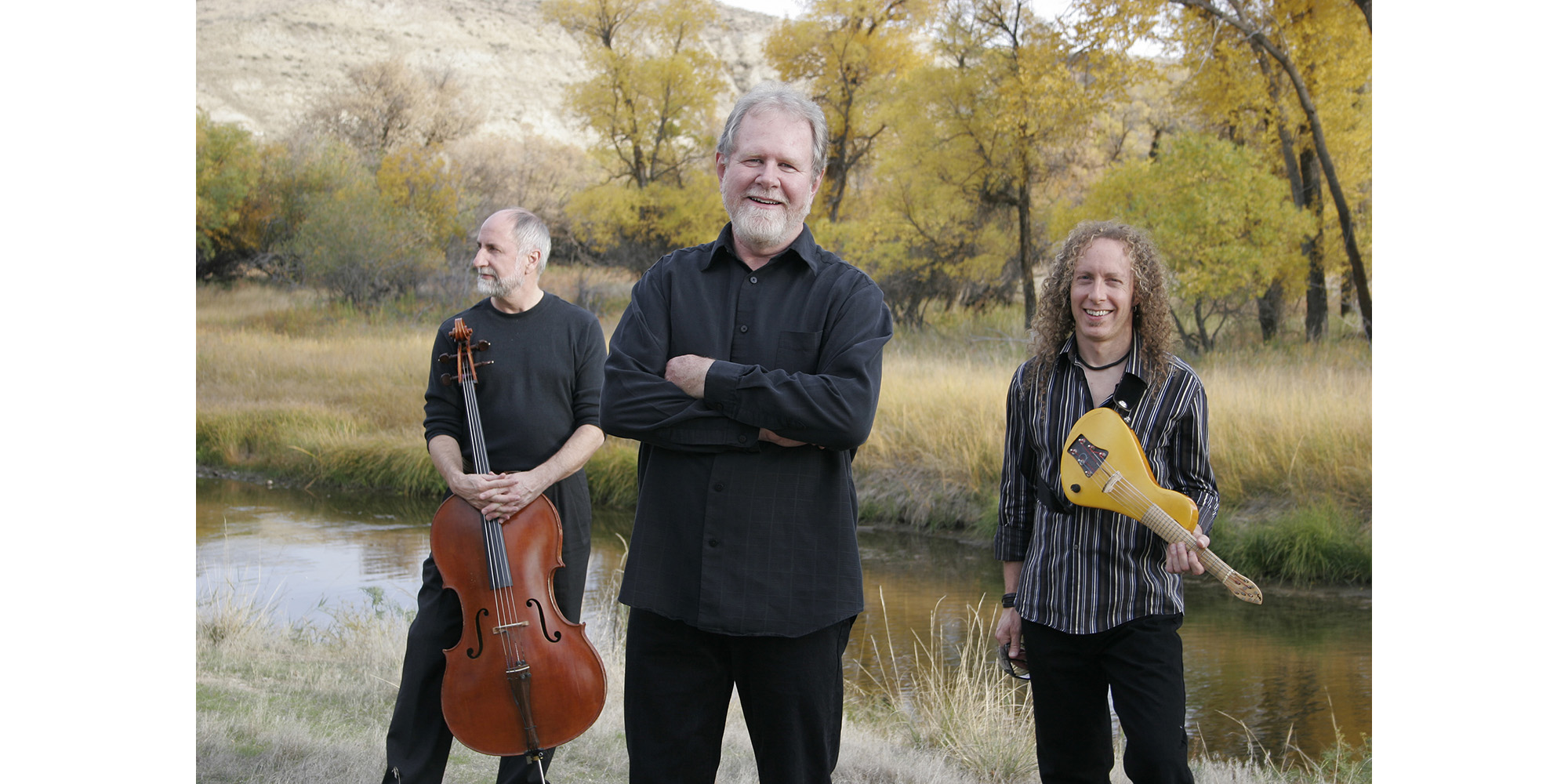
Three Part Invention, an instrumental ensemble of violin, piano and cello will present the fifth and final concert in the 2010-11 Hesston-Bethel Performing Arts Series at 3 p.m. Sunday, April 17, at Hesston Mennonite Church on the Hesston College campus.
The trio, described as “three of the most talented instrumentalists ever to mutate from the classical gene pool,” will perform reinterpretations of classical repertoire as well as original works and pieces from their new, self-titled, all-Bach CD.
Tracy Silverman on both traditional and electric violin, pianist Philip Aaberg and cellist Eric Friesen break the pretenses of classical performance conventions by infusing classical sounds with jazz, pop and world influences.
“We are excited to have these three pioneering giants of classical crossover come together in Hesston to explore the fusion of classical masterpieces with jazz, blues, New Orleans roots music and free improvisation,” said HBPA director Matthew Schloneger.
All three musicians have roots in the classical style and bring contemporary sounds of rock, world influences and jazz to their solo careers as well.
“Area arts patrons may be familiar with all three members of Three Part Invention,” said Schloneger. “Tracy Silverman performed spectacularly as an electric violin soloist with the Wichita Symphony Orchestra last year, and Philip Aaberg and Eugene Friesen have appeared in various venues across Kansas over the last several years, including the Stiefel Theatre in Salina, the McPherson Opera House and the Lawrence Arts Center.”
Aaberg, a Grammy nominated pianist, was the recipient of the Leonard Bernstein Music Scholarship at Harvard where he honed his piano and chamber music skills and was invited to participate in the Marlboro (Vermont) Music Festival, which is known worldwide for developing musical leaders. Aaberg has performed his American West-inspired music around the world in solo concerts and with major orchestras such as the Boston Pops Orchestra. He has also worked with a diverse group of artists including Peter Gabriel, Elvin Bishop, John Hiatt, Maria Muldaur, the Doobie Brothers and The Paul Dresher Ensemble. In 1995 he received the State of Montana Governor’s Award for the Arts.
Silverman is a graduate of Juilliard (New York, N.Y.), and has been recognized as the leading figure in the field of electric violin. Pulitzer-prize winning composer John Adams wrote the electric violin concerto “Dharma at Big Sur” expressly for Silverman, who was praised by the BBC as “the greatest living exponent of the electric violin.” He was first violinist with the San Francisco-based Turtle Island String Quartet, which was the first string quartet to achieve success with rhythms and improvisations. Silverman teaches jazz violin in Nashville at both Belmont University and Vanderbilt University’s Blair School of Music.
Cellist Eugene Friesen’s long tenure with the Paul Winter Consort, one of the earliest representatives of world music, has established him as one of the first and greatest contemporary improvising cellists. Friesen’s gift for improvisatory music has been featured worldwide with Trio Globo and poets Yevgeny Yevtushenko, Robert Bly and Coleman Banks. He won Grammy awards in 1994 and 2006 for his contributions to two Paul Winter Consort recordings. Friesen’s original compositions have been performed by the Kansas City Symphony, the Colorado Orchestra, Milwaukee Symphony, New Jersey Symphony and others. Friesen teaches at the Berklee College of Music in Boston and is artist-in-residence at the Cathedral Church of Saint John the Divine in New York City.
In addition to the HBPA concert appearance, the trio will do a number of educational activities with grant support from Mid-America Arts Alliance.
Silverman will perform on electric violin at 9 a.m. April 15 at Chisholm Middle School (Newton), at 11 a.m. as part of Bethel College’s (North Newton) convocation and at 2 p.m. at Wichita East High School.
The trio will also host an improvisation workshop at 10 a.m. April 16 at Hesston Mennonite Church. Intermediate and advanced instrumentalists of any instrument are invited to participate. The event is free and open to the public.
Single ticket prices for Three Part Invention range from $14 to $17, depending on seating section, with discounts available to students and senior citizens.
For more information or to purchase tickets, call 620-327-8158 (Hesston College) or 316-284-5205 (Bethel College), email hbpa@hesston.edu or visit the HBPA website at www.hesston.edu/hbpa.
This program is presented in part by the Kansas Arts Commission, a state agency, and the National Endowment for the Arts, a federal agency, which believes a great nation deserves great art, and is supported by Mid-America Arts Alliance, with generous underwriting by the National Endowment for the Arts, the Kansas Arts Commission and foundations, corporations and individuals throughout Arkansas, Kansas, Missouri, Nebraska, Oklahoma and Texas.
The Hesston-Bethel Performing Arts Series, now in its 29th year, started in 1982 as the Hesston Performing Arts Series (HPA) with funding and planning provided by Hesston College and the Hesston community. In 1998, HPA planners launched a partnership with Bethel College (North Newton) and the name changed to Hesston-Bethel Performing Arts. Hesston College and Bethel College host five performances by world-renowned or regionally acclaimed artists each year.
Impacting the world one student at a time
Bible and Ministry
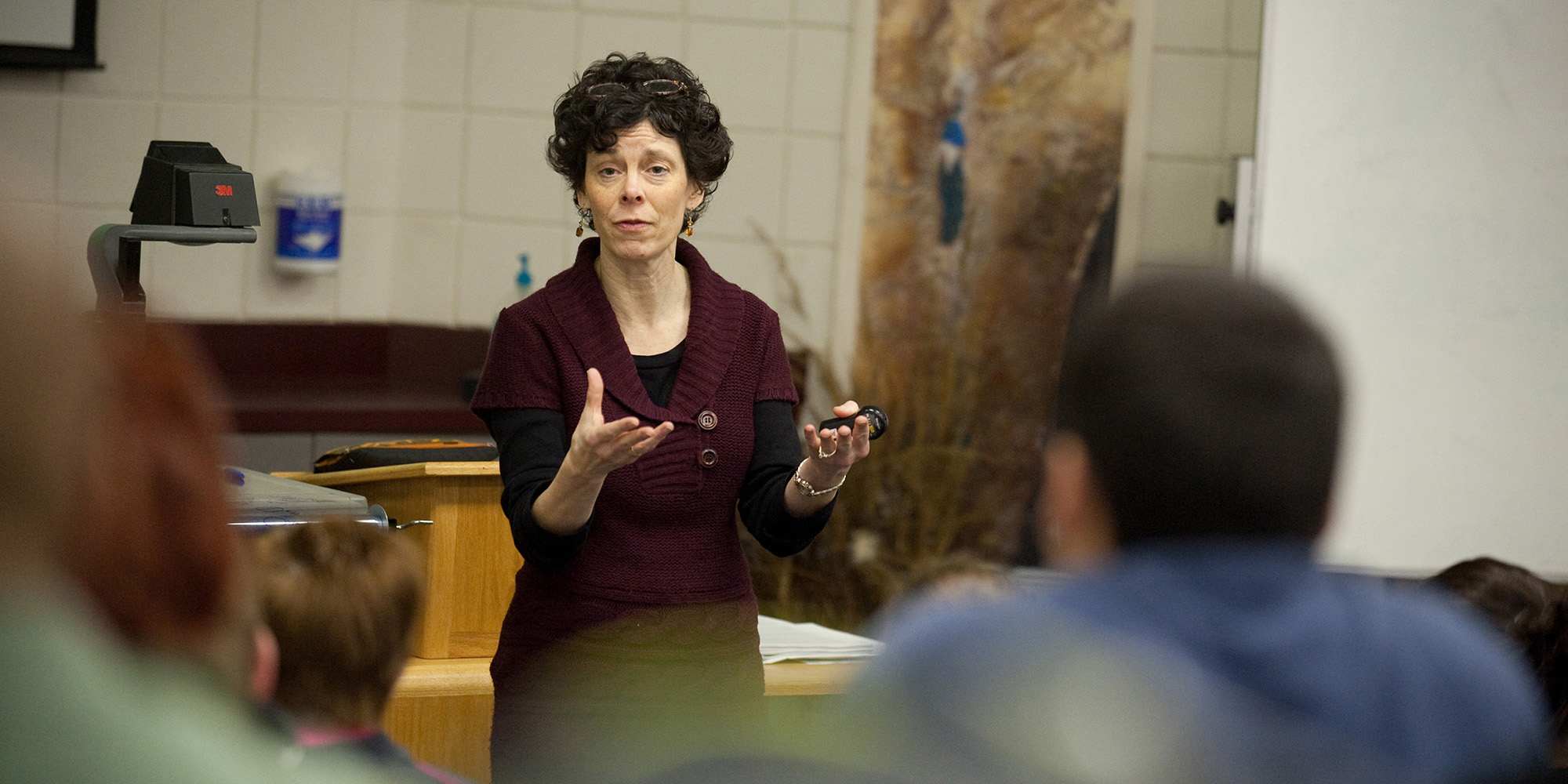
Bible and Religion professor Marion Bontrager taught the first Biblical Literature class at Hesston College in 1986. As Bontrager’s brainchild, the class was meant to ensure that students would receive biblical teaching from an Anabaptist perspective as part of their core curriculum.
The impact the class would have on the students who spread its reach to their churches, communities and careers was not part of the immediate vision.
In the 25 years Bib Lit – as it is affectionately called – has existed at Hesston College, more than 5,000 students have been through the class. As those students fulfill the “go everywhere” the college proclaims, they take with them an expanded worldview, a new way of reading the Bible and a broader understanding of their own faith.
“Bib Lit is impacting the church one student at a time,” said Bontrager. “Students go home and share what they learned with their churches.”
Josh Miller, a 1999 graduate, enrolled in Bib Lit his first semester. Miller grew up attending Mennonite and Presbyterian churches and took his faith seriously. The semester of Bib Lit would prove to be instrumental in his call to ministry.
“In Bib Lit the Bible came to life in a new way,” said Miller. “For the first time, I saw how the entire biblical story fit together as a whole and how it continues in the mission of the church.”
Now an Anglican priest in Pittsburgh, Pa., Miller recognizes the impact Bib Lit has on his day-to-day life and ministry.
“When congregants say that a sermon helped them, I know one of the reasons it did so is because of the foundation laid in Bib Lit,” said Miller. “It was there that I learned not to take anything for granted in a passage, and that the church was called to be a group of people who reach out to the world in love, spreading God’s Kingdom in tangible and spiritual ways.”
Bib Lit begins with inductive Bible study, which looks at the Bible in its historical context instead of reading passages from a modern understanding. The course then weaves together everything from Genesis to Revelation, moving into church history and the present, and reveals the Bible as a narrative of God and the people of God, more than a compilation of stories.
The class refers to the narrative as “Heilsgeschichte,” a German word meaning salvation history. As the students move through Heilsgeschichte, they learn to understand different approaches to interpretation and how that affects the way they read the Bible. A major portion of each student’s grade is retelling Heilsgeschichte either through oral presentation or written format.
“The class builds a foundation for critical thinking and analysis when studying the Bible or in any area of life or academics,” said Bontrager.
For sophomore Samantha Brouwer, Moundridge, Kan., Bib Lit was an opportunity for discovery.
“I didn’t grow up going to church,” said Brouwer. “Everything about Bib Lit and the Bible was new to me.”
As she spoke Heilsgeschichte to Bontrager at the end of the semester, Brouwer said she found herself in tears.
“I finally realized that God wants a relationship with people, and I didn’t have that relationship,” she said. “Marion talked with me and helped me realize that it’s not too late to begin to know God. Bib Lit helped me become more in touch with myself and the ways God is calling me.”
Bontrager has team-taught the class with other instructors since its inception, and he says the partnerships have improved the course.
Michele Hershberger, chair of the Bible and Religion department, began teaching the class with Bontrager in 2000. During the 2009-10 year, Hershberger spent her sabbatical teaching Bible courses at LCC International University in Klaipeda, Lithuania, where she introduced Bib Lit to her students.
“About 90 percent were atheist or agnostic, and many were hostile to taking the class” said Hershberger. “I tried to be non-defensive and caring and just let the Bible speak for itself. It worked.”
Bontrager and Hershberger travel to Mennonite churches and conferences across the country presenting condensed versions of the course for church leaders and congregations.
The class is also taught at the Ellsworth (Kan.) Correctional Facility and was recently introduced in churches in Vietnam through former Pastoral Ministries Director Palmer Becker.
Even as Bib Lit stretches beyond the Hesston College campus, its foundation is strengthened with each student who emerges from the class ready to share their exciting new discoveries.
“I love seeing that light-bulb moment when students make a connection they have never made before,” said Hershberger. “Bib Lit brings a sense of common experience and story, both the biblical story that students come to understand in a deeper way and the story of their journey through the class itself. In that way, Bib Lit builds community.”
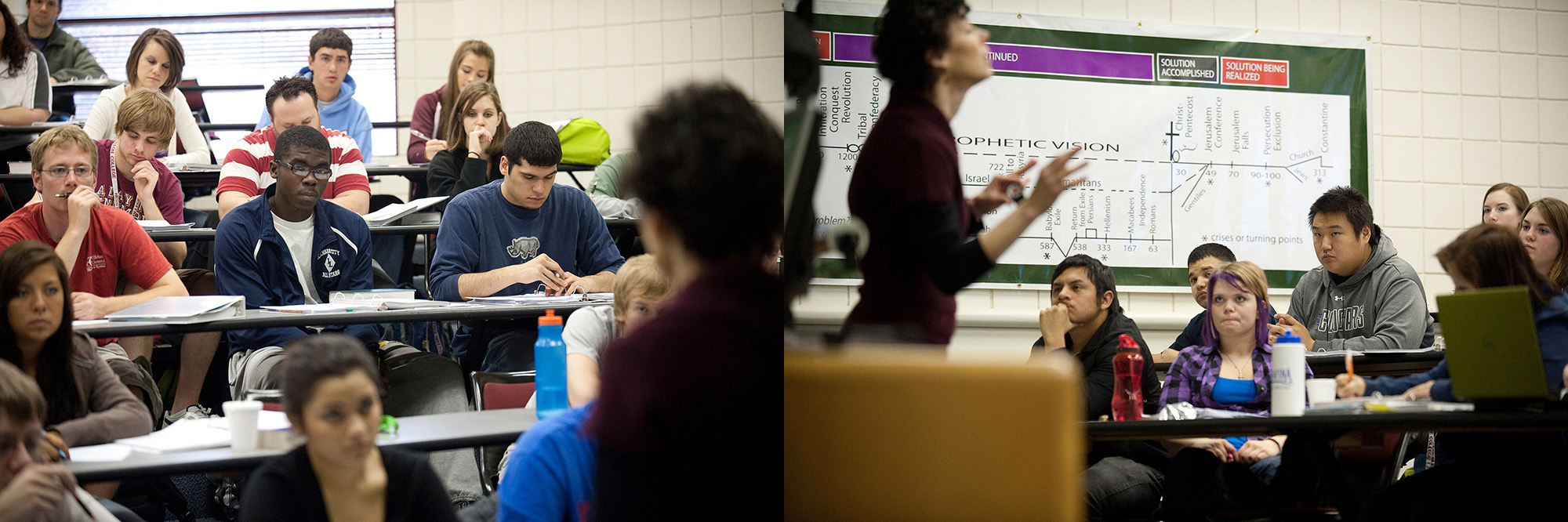
Hesston College freshmen (from left) Shuvo Das from Mohammadpur, Dhaka, Bangladesh; Delmar Reyes from Hugoton, Kan.; Elyse Terry from Bluffton, Ohio; and Andrew Penner from Fresno, Calif., engage in an explanation during Bib Lit class.
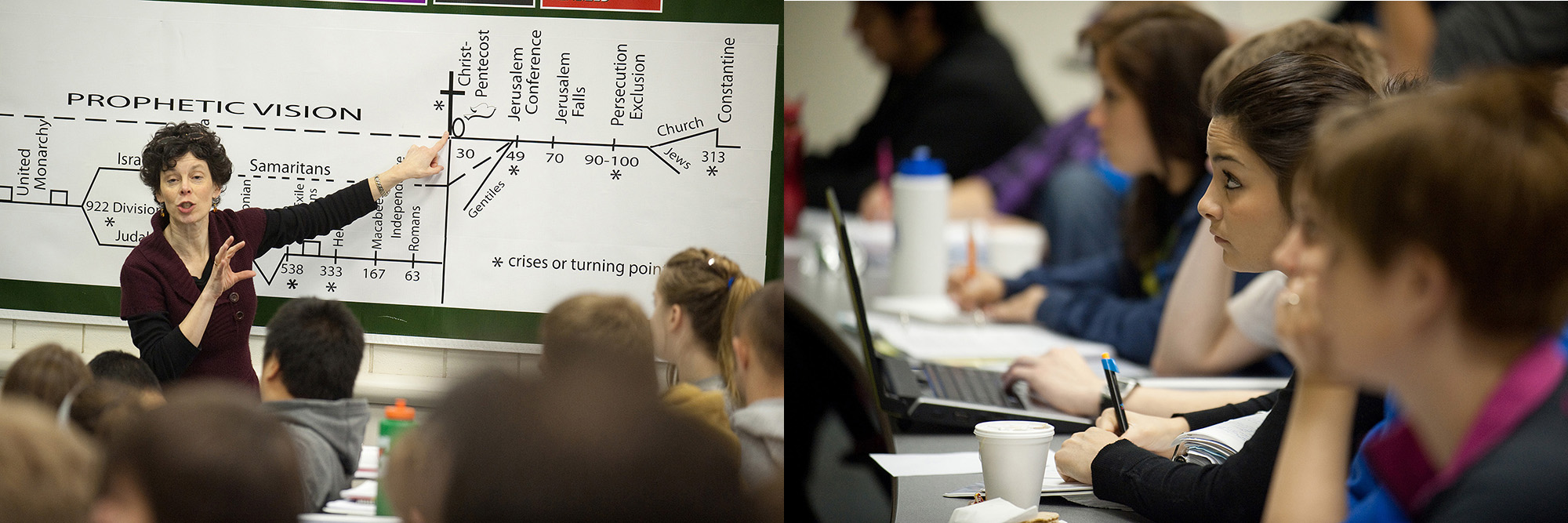
(left) Michele Hershberger uses a timeline to explain where Biblical events fall in Heilsgeschichte; (right) Freshman Andrea De Avila Balboa from Matamoros, Mexico takes notes on Heilsgeschichte during a Bib Lit class.
Hesston College celebrates Grandparent Days
General
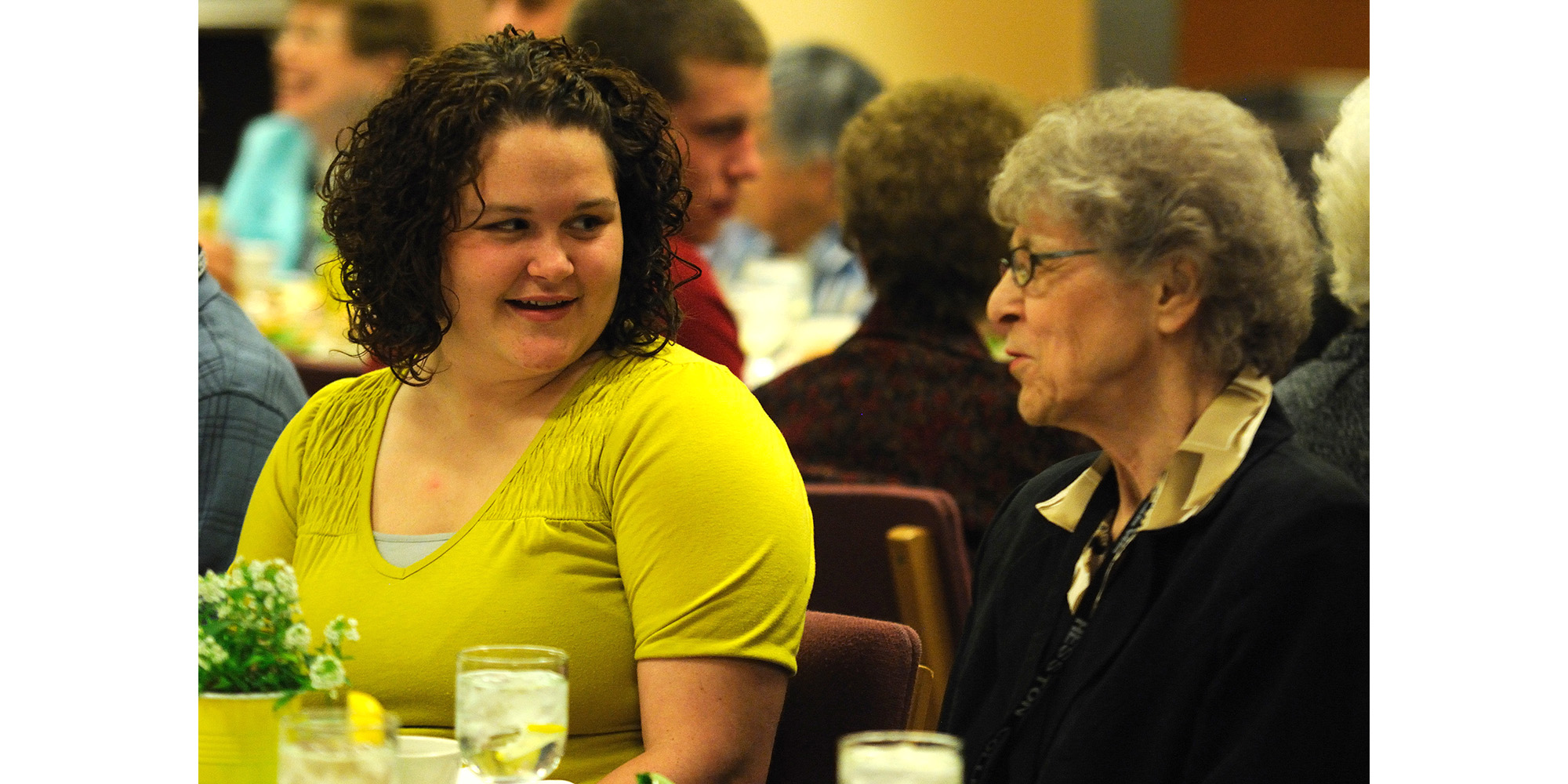
“I remember when Grandma lived in Pennsylvania, she would let us go to the creek and catch crawdads,” says Hesston College freshman Courtney Mast of Weatherford, Okla. “After we caught a bunch, we would go back to the house and sit outside while we cleaned them, then Grandma would let us cook them inside. Mom never let us do that.”
Mast had many fond memories to share about her grandmother Mari An Nyce, also of Weatherford, during Hesston College’s annual Grandparent Days March 24 and 25. The annual event drew 69 grandparents of 41 students from six states. Grandparents were invited to attend sessions on “Yesteryear’s Farm Life” lead by Dwight Roth and various Hesston faculty and staff. Students in Kevin Wilder’s Developmental Psychology class also interviewed guests on the topic “Adolescence of Yesterday and Today.”
Nyce did not attend Hesston College, but all three of her children, a son-in-law, a granddaughter (Kaitlyn Mast ’10) and now Courtney spent the first two years of their college life at Hesston.
“The relationships my children made at Hesston College are lasting,” said Nyce. “My kids still get together with the friends they made during those two years.”
“I saw the motto, ‘Start Here, Go Everywhere,’ used by my kids. Both Steve and Anita worked in the preschool at Hesston and they used that to do daycare in Mennonite Voluntary Service after they graduated,” said Nyce.
Students and their grandparents attended a banquet, and students shared stories or memories about their grandparents.
Freshman Wendy Whitcher of Hesston, Kan., said that she remembers playing Monopoly with her grandma, Mary Erb.
“I always thought she was really good at the game until I got older,” Whitcher said. “Then I found out that she was cheating.”
“Grandparent Days are one way to continue the grandparent-child relationship at the young adult level,” said Dallas Stutzman, director of Alumni and Church Relations. “Also, this is a way to provide grandparents an opportunity for continuing education. They have a lot to contribute.”
The continuing relationship is one thing Mast appreciates. “Having my grandma here was fun. It was fun just being able to see her and catch up,” she said.
by Jennifer Kaberline