
In the News
September 22, 2026
Hesston College student wins inaugural Peace Talks competition
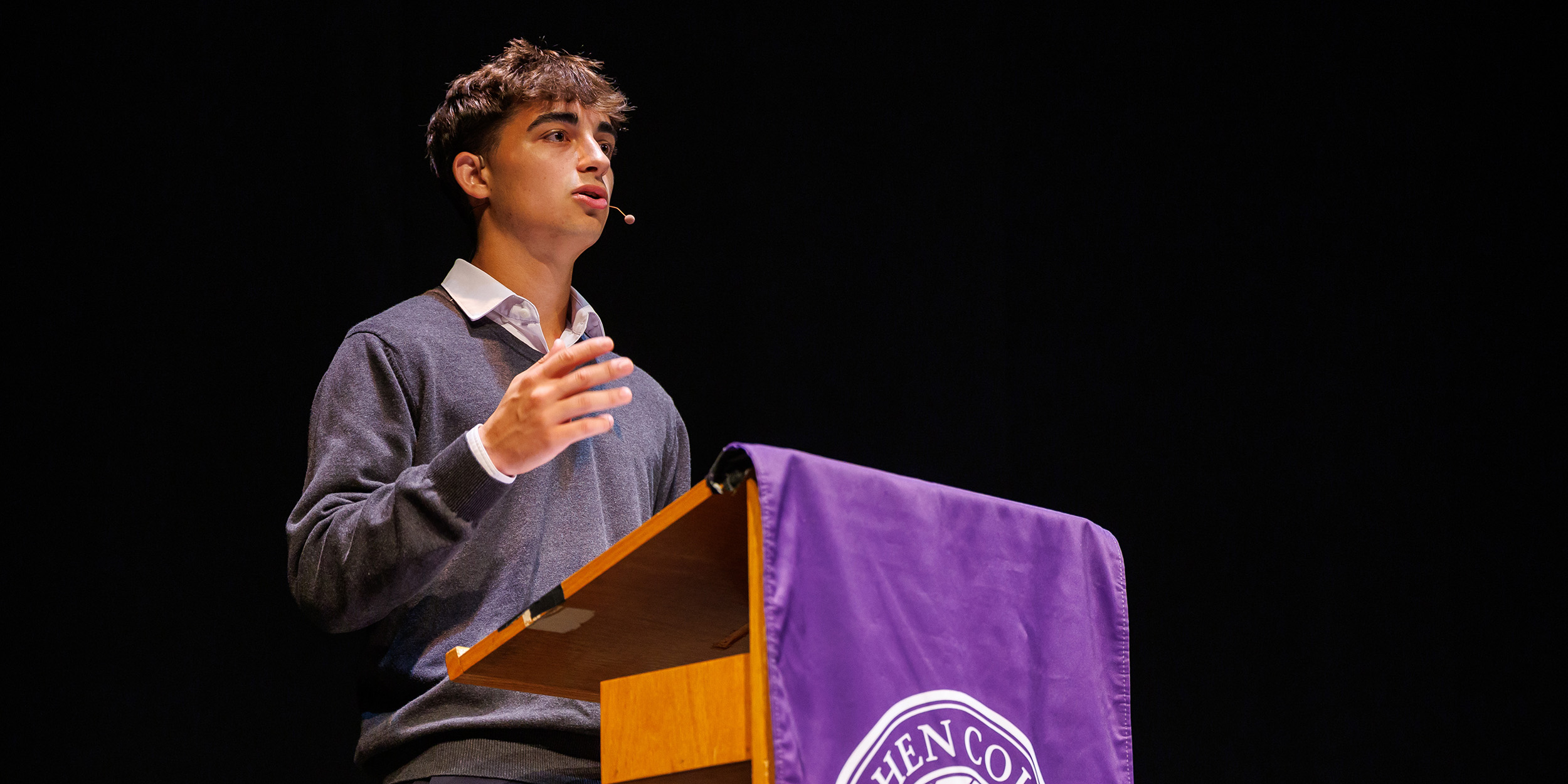
Hesston College sophomore Mateo Gonzalez turned a personal connection to restorative justice into a first-place finish at the inaugural Peace Talks competition Saturday, September 19, at Goshen College in Goshen, Ind.
Gonzalez, an engineering student from Madrid, Spain, was one of five college students invited to compete in the first-year event. His speech, “More Than a Sentence: Exploring Restorative Justice,” challenged listeners to consider how justice can extend beyond punishment.
“My speech explores the limitations of purely punitive justice and advocates for a restorative approach that fosters healing and true accountability,” Gonzalez explains. “Through personal reflections, biblical examples like Jesus and Zacchaeus and the inspiring story of Reginald Dwayne Betts, I argue that people are more than their worst mistakes and deserve the chance for redemption.”
For Gonzalez, the subject was more than an academic exercise. His interest in restorative justice began with a story much closer to home.
“I think what made my speech stand out was the personal connection behind it and the strong foundation of the topic itself,” Gonzalez says. “My speech was inspired by a documentary my mom made about a juvenile intervention program (Before It’s Too Late), which allowed me to speak with genuine passion and real conviction about restorative justice.”
Gonzalez’s path to the Peace Talks stage began last semester on the Hesston College campus through his participation in the C. Henry Smith speech contest in May.
“When I found out I was selected to advance to the national Peace Talks competition, it was definitely a pleasant surprise, but it also motivated me to start refining and practicing my speech again for the next contest,” Gonzalez shares.
For its inaugural year, Peace Talks used participation in the C. Henry Smith contest as the basis for inviting students to compete. The two competitions remain separate, with the C. Henry Smith contest continuing independently. Gonzalez has also entered that competition via video submission; results are expected to be announced in October.
Hesston College Campus Pastor and Bible Professor Nick Ladd accompanied Gonzalez to Goshen and watched his speech continue to develop throughout a full day of workshops, coaching and preparation, all of which Gonzalez soaked up with a positive attitude and coachable spirit. Ladd notes that while Gonzalez brought together a real-life story, supporting information, biblical examples and a relatable call to action, his approach to the preparation process also stood out.
“By 7 p.m., when the contest started, the contestants were all very tired and worn out,” Ladd explains. “I believe another thing that helped Mateo in that moment was his experience from playing soccer at HC. He knows what it is like to be exhausted at half time of a game and still pull together his strength, energy and courage to go play hard for another 45 minutes for the second half.”
After hours of preparation and facing a strong group of fellow speakers, Gonzalez says the nerves of the moment quickly gave way to a connection with those listening.
“Performing in the final round was an incredible experience,” Gonzalez recalls. “Naturally, there were some nerves given the stage and the high level of all the contestants, but once I started speaking, I felt deeply connected with the audience and to the message I was sharing.”
That connection ultimately resulted in Gonzalez being named the first winner in the competition’s history — an outcome he wasn’t expecting as he waited for the results.
“When I heard my name announced as the winner, it was a big surprise because all of the other contestants did such a fantastic job,” Gonzalez says.
The victory also gave Gonzalez an opportunity to represent Hesston alongside students from other established four-year colleges. For Ladd, seeing a Hesston student distinguish himself in this competitive field was especially meaningful.
“It was such an honor and privilege to walk alongside Mateo for this event,” Ladd says. “I hope that his experience will also help bolster excitement for other students to participate in the contest this year.”
Beyond the first-place result, Gonzalez came away from Goshen valuing the people he met and the experiences surrounding the competition itself.
“Peace talks was an incredible experience and opportunity not only because of the well prepared contest itself, but also because of all the activities and workshops we did,” explains Gonzalez. “I will never forget the people I met and the great time I had in Goshen.”
Placing second in the Peace Talks competition was Katherine Brown of Tabor College (Hillsboro, Kan.) with her speech titled, “The Woman on the Corner: Prostitutes are People too.” Other finalists included Caoimhe Farrell of Goshen College, Sophia Kauffman of Conrad Grebel University College (Waterloo, Ontario) and Preston Vicenzi of Bethel College (North Newton, Kan.).
Peace Talks is a new annual public speaking event focused on faith-based storytelling about peace and justice and is part of More Than Just Stories, a Goshen College initiative funded through a five-year, $5 million grant from Lilly Endowment Inc. For more information about the competition, Gonzalez’s speech and the other finalists, visit the Peace Talks contest recap.
Photo (courtesy of Peter Ringenberg Photography):
Mateo Gonzalez of Hesston College won first place at the inaugural Peace Talks contest held at Goshen College on September 19 for his speech, “More Than a Sentence: Exploring Restorative Justice.”
Mateo’s speech: More Than a Sentence
At sixteen years old, Reginald Dwayne Betts participated in a carjacking. He was sentenced as an adult and spent eight years in maximum-security prisons. For years, Reginald imagined his freedom. A second chance. A new beginning. But when he finally walked out of prison carrying a small bag in his hand, he discovered something painful: although his sentence had ended... society’s judgment hadn’t. For many people, he was still “the criminal.” Still dangerous. Still defined by the worst thing he had ever done.
I want all of you, just for a moment, to think about the worst mistake you have ever made. Not the mistake everyone knows about. The one you truly regret. The moment you wish you could erase (big pause) . Now imagine that from this day forward, no one ever lets you move beyond it. In every new relationship, people see only that mistake. They define you by it forever. For many people who have caused harm, that is exactly what life feels like. And maybe that’s what troubles me most. Not only what people do when harm occurs... but what happens afterward. How quickly we punish. How easily we label.
Because when trauma strikes a person, a family, or an entire community, what kind of justice is truly capable not only of punishing wrongdoing, but of restoring healing, dignity, and peace?
Today, we live in a culture deeply shaped by punishment without restoration. We see it in schools, communities, and everyday relationships. A student cheats once and suddenly becomes “the cheater.” A person leaves prison after years... but society never allows them to leave their past behind. Punishment isolates. Restoration reconnects. And while punishment may satisfy anger for a moment, we must ask ourselves something deeper: does it actually heal? If punishment leaves victims still hurting, offenders hopeless, and communities divided — has justice truly been served?
The numbers tell us a painful story. According to the U.S. Department of Justice, nearly 67% of released prisoners are arrested again within three years. Behind that number are real people and families. Punishment alone often becomes a revolving door. But restorative justice offers something different. Research consistently shows that when victims and offenders participate in restorative dialogue processes, victim satisfaction increases and reoffending decreases. This isn’t simply an idealistic theory. It is a vision of justice that creates real accountability while also creating the possibility of healing. Maybe this is where our idea of justice begins to change. Because perhaps justice was never meant only to punish evil... but also to restore what evil has destroyed. What if justice could do more than punish? What if accountability and healing were not opposites?
However — I want to be honest with you. Restorative justice isn’t simple. For a victim to sit across from the person who hurt them — to speak, to remember, to reopen that wound — takes extraordinary courage. Some victims are not ready for that conversation. Some may never be. And restorative justice recognizes that too. But it still asks us to believe something difficult: that human beings are more than the worst thing they have done. That even after deep harm, healing is still possible. That the wound is not always the final word.
Like Zacchaeus in the Gospel of Luke, who after recognizing the harm he had caused chose not only to apologize but to restore what he had taken, restorative justice asks people to seek repair instead of simply avoiding consequences. But I want to stay with Zacchaeus for just a moment longer, because what impresses me most isn’t the repayment. It is what happened before that. Jesus looked up into that tree and called him by name. Not “the tax collector.” Not “the sinner.” By name. In that single act, Jesus refused to let a label become a permanent identity. And perhaps that is where restoration always begins.
This choice is not only made in prisons or courtrooms. Growing up in Spain, I remember that when conflicts happened in school, the goal wasn’t always immediate punishment. Sometimes, instead of simply sending students home, teachers would bring people together to talk and to confront the harm directly. Looking back, those moments taught something deeper than punishment: they were teaching responsibility, dialogue, and restoration. We live in a generation that has grown up with screenshots, where a message sent at fifteen can define you at twenty-five, where the internet never forgets — and rarely forgives.
And maybe we, more than any generation before us, understand what it means to be reduced to a single moment — to be seen as a post, a mistake, a label, and never as a person still becoming. Even here, in communities like Hesston College, we face this question every day. When conflict appears in dorm rooms, classrooms, friendships, or teams, do we choose the quick punishment that isolates... or do we have the courage to pursue the conversations that restore?
And into a world that also knew how to reduce people to their worst moment, Jesus walked differently. Again and again, Jesus challenged condemnation without ignoring harm. When the woman caught in adultery was brought before Him, surrounded by people ready to stone her, Jesus responded: “Let any one of you who is without sin be the first to throw a stone.” He did not deny wrongdoing. But He also refused to reduce a human being to their worst mistake. The crowd dropped their stones and walked away. And when they were gone, Jesus didn’t move on quickly. He stayed. He looked at her — truly looked — and said: “Neither do I condemn you.” Not because her wrong didn’t matter. Not because what happened was acceptable. But he said: you are still more than this. Go, and begin again. That word — go — is not an erasure. It is an invitation. To a new beginning that punishment alone could never offer.
Perhaps that is what Christian peace truly requires from us. Not the absence of accountability and not excusing wrongdoing— but the difficult work of healing broken relationships and believing that redemption is still possible. Peace is more than the absence of violence. Peace is reconciliation.
Imagine a society where every mistake becomes a permanent identity. Where shame follows people longer than any sentence. Where communities know how to punish... but no longer know how to heal. Now imagine something different. A society where victims are truly heard, where accountability still exists but so does the possibility of transformation. Where justice doesn’t end with suffering, but leaves room for healing.
Reginald Dwayne Betts didn’t remain trapped in his worst mistake. Today, he is a Yale-educated lawyer and an award-winning poet. His story forces us to confront a difficult question: how many lives do we lose when we decide that people can never become more than their worst moment?
Reginald Betts still carries a small bag everywhere he goes. Not the one from prison — a different one. A bag with notebooks, drafts, words he is still writing. Because the story didn't end when he walked out of that prison. It began. And maybe that is the deepest truth restorative justice asks us to hold: that every person still has a story that is not finished yet. That the worst chapter cannot be the last one. That justice — real justice — leaves room for the next page to be written.